5 cooking terms that no longer frighten me

There are only so many amusing anecdotes you can squeeze out of hot dogs, chicken burgers, tacos, and pizza; and if cooking the same things every week is tedious, then writing about cooking them is enough to make you want to hurl yourself into a cooking pot.

Thus, my weekly “What’s for Supper?” posts (see sidebar), which are hurtling toward Vol. 100 in a matter of months, have propelled me to learn more about cooking than I picked up in the first fifteen+ years of marriage.

To my delight, lots of cooking terminology that seemed so complicated and sophisticated is pretty basic stuff, and well within my grasp– as long as I look it up ahead of time, and don’t attempt to learn a new technique on the fly. Here are a few:

1. Braising

 I was under the impression that braising required leaping flames, arcane implements made out of brass or copper, and possibly some shouting. Turns out I have been braising all my life. It’s is a two-step process for cooking flavorful meat, where you use high, dry heat first (searing), then low, moist heat (stewing). For more details, see “Four Simple Rules for Braising Anything” from Bon Appetit.

2.  Deglazing

In my head, deglazing could only be accomplished by a subtle but masterful motion of the wrist and split-second timing. Actually, it just means you’re done cooking something up in a pan, and you don’t want to waste all those yummy little blackened scraps and flavorful gunk that’s stuck to the bottom. So you dump in a cup of broth or wine or whatever, and scrape it up, incorporating all the good stuff. That’s it. Adds tons of flavor and makes the pan easier to wash, too.

3. Caramelizing

  I always thought this involved some kind of sugar syrup, because, duh, “caramel.” I was half right. Caramelization is an irreversible chemical process wherein water is released and sugar is broken down, producing a characteristic flavor. Sometimes you do add sugar, as when you’re caramelizing carrots or nuts; but onions already have sugar in them. (Many vegetables have sugar in them, actually, but wonderful things happen when you call it forth from onions in particular.)

The only thing you need to know about caramelizing onions is that it takes forehhhhhhhver. I always figure on 40 minutes. If you see an article titled “How to caramelize onions quickly,” spit bitterly upon the floor and turn away, because it’s a dirty lie. More tips for caramelizing onions well from Bon Appetit. More grousing about the fog of deceit surrounding the issue from Slate.

4. Chiffonade

Not, it turns out, a term for those weird paper booties they put on the turkey in Amelia Bedelia. Nope, a chiffonade is just what you get when you take a bunch of edible leaves, roll them up, and then slice them into thin ribbons. Pretty important if you still have Instagram friends who won’t blacklist you on account of your wantonly frequent photos of soup. WANTON soup, get it?

But seriously, adding a garnish of greens on top of a dish isn’t just to make it pretty. Fresh herbs have a different taste from the ones cooked in, and they will give the finished dish lovely boost in flavor.

5. Pickling

This one doesn’t quite belong in this list, oh well. Everyone knows what pickling is (and I tried it once. Only once. Mold, salt, broken glass, crushed dreams, and a cabinet that will never smell the same. So now I buy my pickles), but did you know you can quick pickle stuff? Like, you can pickle in the morning and eat it for dinner?

Take some carrots, radishes, cucumbers, daikon, or whatever, and slice it thin, and chuck it in a jar with some vinegar (any kind) and a little water, and stir in some sugar or honey. By meal time, they will be exciting, and you can make a boring sandwich feisty and fun.

How about you? Have you gotten past some intimidating technical terms?
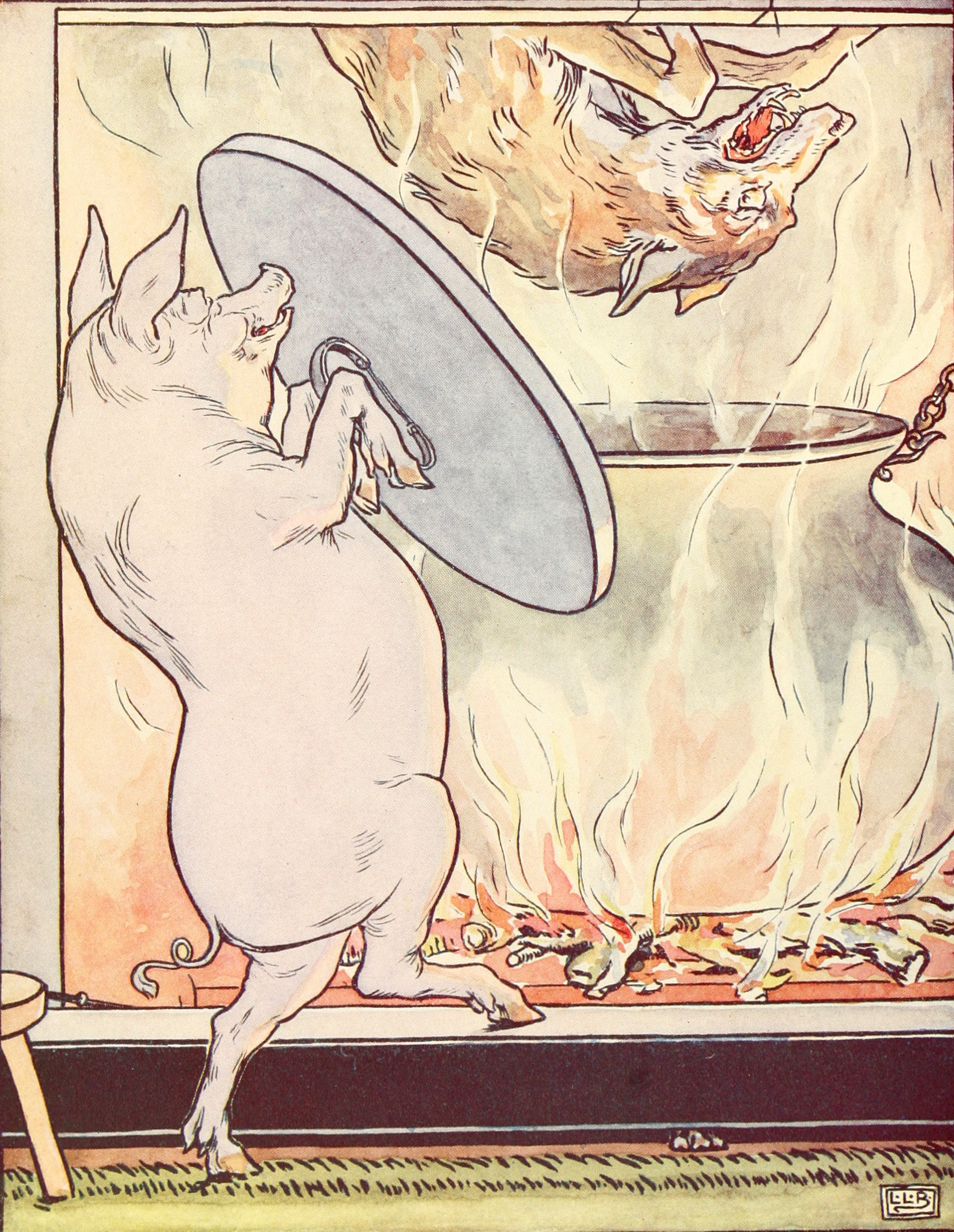
And how do we feel about that pig eating the wolf who ate his brothers, anyway? Can we assume that, since the three of them went their separate ways and had such widely divergent worldviews vis a vis homebuilding and security, maybe the third pig actually derived some brutal satisfaction from knowing what that wolf’s flesh was made of? Or did he just boil him EXECUTION SYTLE but not eat him? Or what?

***
Pig and wolf picture by Leonard Leslie Brooke (1862-1940) (http://www.gutenberg.org/etext/15661) [Public domain], via Wikimedia Commons
F
ood images:
Caramelized onions: Stacy Spensley via Flickr https://www.flickr.com/photos/notahipster/7376763436 (Creative Commons)
Chiffonade: Stacy Spensley via Flickr https://www.flickr.com/photos/notahipster/7376763436 (Creative Commons)
Deglazing: Scott Feldstein via Flickr https://www.flickr.com/photos/scottfeldstein/5635765929 (Creative Commons)
Braising: via Pexels https://www.pexels.com/photo/red-meat-dish-25273/
Pickled veg: ih via Flickr https://www.flickr.com/photos/irisphotos/14680773562 (Creative Commons)

I thought Good Catholics didn’t need therapy. Then I went.

Sometimes, I have to take my therapist’s words with a grain of salt or filter them through a Catholic lens. More often, I discover that my lifelong spiritual failings are actually emotional wounds. And as they heal, it becomes easier to follow Christ.

Read the rest of my essay for America magazine.

The Year of Mercy logo stinks, and it’s okay to say so.

Since I cannot seem to write anything intelligible today, here’s something intelligible I wrote several years ago. Still useful today, as we discuss the World Youth Day logo and how much it stinks. The Year of Mercy has a logo, and it stinks!

See?

See?

When I saw the logo, I wondered if there were some obscure two-headed saint on skis that I had forgotten about. Some of my friends strongly disagreed, and said that it was clearly the Two Headed Monster muppet, or possibly Lucille Bluth. This elicited a very typical response among Catholics on social media: aw, let’s be nicer. What would the artist’s mom think if she saw these nasty comments? Why can’t we come up with something positive to say? We should be supporting each other, not tearing each other down. And so on.

So here are my thoughts (which I originally published in 2011, after the Kincade Kerfuffle) about what Christians can do, without sinning, when confronted with a public work of art:

***

The Christian critic may criticize someone’s work in the bluntest terms.  Once you put something out for public consumption, it is open for criticism, period.  Attacking the person, his motives, or his soul is another thing, which I avoid; but the idea that criticizing someone’s work is the same as judging his soul?  That’s just bananas.

The Christian critic may criticize the work of fellow Christians.  I often hear, “We Catholics should be standing together, not tearing each other down!”  But how does it build up the Body of Christ to pretend that second-rate stuff is good?  The world already thinks Christians are cultural morons, incompetent, uneducated, and hypocritical.  If we call something that’s mediocre a triumph simply because it doesn’t have any cussing in it, we’re just reinforcing the idea that Christianity is lame and worthless.  Hardly a service.

The Christian critic may criticize someone’s work when the work’s creator is going through a hard time. If I had a friend whose mother had just died, I wouldn’t choose that moment to rebuke him about his personal hygiene.  But if a professional puts out a piece of work that’s not very good, it would be gracious to mention any extenuating circumstances as part of my critique—but it’s not necessary, and may not be relevant.  I’m not your mom, and I’m not responsible for researching your personal life before addressing your work.

The Christian critic may criticize something even if the critic has a personal problem.  It’s like the old line, “Just because you’re paranoid, that doesn’t mean they’re not out to get you.”  Just because I’m a neurotic, defensive sorehead, that doesn’t mean I’m wrong.  People who have weak spots or personal problems may actually be the most qualified to identify a true problem.  Anyway, what am I supposed to do, only write about things I don’t care about?

The Christian critic may point to a problem without discovering a solution.  It’s a blog post, not a wonder drug. I’d rather hear an honest, “I don’t know what can be done about this,” than a facile, “If only people would simply do X,Y, and Z, the world would be a paradise.”

The Christian critic may criticize something even if there exists a worse evil in the world.  When I discuss an overlooked aspect of human experience, I inevitably hear, “Oh, sure, let’s pick on Minor Problem B when there is Cataclysmic Problem X in the world!”  Well, do we really need more howling about, “Oh, how great is the sinfulness of sin!  Just LOOK at that sin!  Isn’t it sinful?” That’s just tedious.  And yes, I can truthfully say, “Boy, this sprained ankle hurts,” without implying that a triple amputation is a walk in the park.

The Christian critic may take a closer look at an issue that is usually presented as black-and-white.  Subtlety is not a sin.  For instance, I can say, “People who dress modestly aren’t necessarily virtuous,” and that’s not the same as saying, “Let’s all wear hot pants to Mass.”

The Christian critic may describe people in frank and colorful terms, if the goal is realism, not cruel mockery.  Painting a recognizable verbal picture is not a sin, it’s just descriptive.  Vagueness isn’t the same as charity.  It’s wrong to encourage people to mock and look down on each other.  But if my goal is to be clear and poignant when describing a scene, then specifics are fair play.

The Christian critic may use figurative language without warning, “The following is a metaphor, and not intended as a technical manual or a page from the catechism.”  Helpful readers often suggest that I add the words, “In my opinion” or, “I may be wrong, but it seems to me.”  This kind of verbal clutter helps out writing the same way a crocheted dolly helps out toilet paper.

****

Nobody should write only critical pieces.  No matter how important or interesting the topic, constant criticism gets very tiresome very quickly.

But so does constant niceness.  I try not to hurt people; but offending them?  The more it happens, the more I’m convinced that it’s a service, not a sin.  At least it gives us something to talk about!

RELATED:
Tom MacDonald says: “Beauty can’t save the world if the people responsible for Church design and expression have the artistic sensibility Norman Bridwell.”

Official Vatican Commission: Current Medjugorje apparitions doubtful

The vast majority of phenomena at Medjugorje can not be said to be of supernatural origin, according to most votes cast this week by the official commission on Medjugorje.

The Commission, established by Pope Benedict XVI in 2010, was asked to evaluate separately the first seven apparitions, which allegedly occurred in the summer of 1981, and the tens of thousands of subsequent apparitions, which allegedly continue to this day. The commission includes five cardinals, two psychologists, four theologians, a Mariologist, anthropologist, a canonist, and an official of the Doctrine of the Faith. According to La Stampa, the commission

met 17 times and screened all documents filed in the Vatican, the parish of Medjugorje and the archives of the secret services of the former Yugoslavia. The commission heard all the seers and witnesses involved, and in April 2012, they carried out an inspection in the village of Herzegovina.

Most members of the commission voted that the first seven apparitions were supernatural in nature, and not a hoax or demonic [note that the quotations from La Stampa have been translated from Italian, which accounts for the somewhat clumsy language]:

Members and experts came out with 13 votes in favor of recognizing the supernatural nature of the first visions. A member voted against and an expert expressed a suspensive vote. The committee argues that the six young seers were psychically normal and were caught by surprise by the apparition, and that nothing of what they had seen was influenced by either the Franciscans of the parish or any other subjects. They showed resistance in telling what happened despite the police arrested them and death threating [sic] them. The commission also rejected the hypothesis of a demonic origin of the apparitions.

The commission was much more doubtful about the supernatural origin of subsequent apparitions, though. Regarding the circumstances and nature of the subsequent apparitions themselves,

the commission took note of the heavy interference caused by the conflict between the bishop and the Franciscans of the parish, as well as the fact that the apparitions, pre-announced and programmed individually for each seer continued with repetitive messages. These visions continued despite the youngsters had said they would end, however that actually has never happened. There is then the issue of the “secrets” of the somewhat apocalyptic flavor that the seers claim to have been revealed from the apparition.

Based on the “behavior of the seers,” the commission reports

eight members and four experts believe that an opinion cannot be expressed, while two other members have voted against the supernatural nature of the phenomenon.

Regarding the much-touted “spiritual fruits” of the phenomena, “but leaving aside the behaviors of the seers,” La Stampa reports

3 members and 3 experts say there are positive outcomes, 4 members and 3 experts say they are mixed, with a majority of positive, effects and the remaining 3 experts claim there are mixed positive and negative effects.

Thirteen of the fourteen commission members have voted to put Medjugorje directly under the authority of the Vatican. The establishment of an authority that answers to the Vatican “would not imply the recognition of the supernatural nature of the apparitions,” but would aid the Church in overseeing the pastoral care of the millions of pilgrims who visit the region every year.

These pastoral developments would also provide “clarity on economic issues.” Commerce related to Medjugorje has become a global industry, producing steady income for some of the alleged visionaries.

On his way home from Fatima, Pope Francis told reporters Saturday that he had “worse” than doubts about the authenticity of the phenomena at Medjugorje. The Pope said:

The report has its doubts, but personally, I am a little worse. I prefer Our Lady as mother, our mother, and not Our Lady as head of the post office who sends a message at a stated time.

This isn’t Jesus’ mother. And these alleged apparitions don’t have much value. I say this as a personal opinion, but it is clear. Who thinks that Our Lady says, ‘Come, because tomorrow at this time I will give a message to that seer?’ No!

For an extensive explanation of the many concerns and alarms surrounding the alleged apparitions, see my essay in The Catholic Weekly, The Lady of Medjugorje Is Not Your Mother.

________
NOTE: This post was edited at 10:55 AM eastern on 5/17/17. The first sentence originally read: “The vast majority of phenomena at Medjugorje are not of supernatural origin, according to most votes cast this week by the official commission on Medjugorje.” I do not believe this statement is inaccurate, but the edited version is more clear. 

***
Image of a cross at Medjugorje by Miran Rijavec via Flickr

The FYOOOTURE of this site and podcast

Maybe you noticed that I put some ads on this site. I want to know how that’s working out for you; and I want to know what you’d like to see and hear from my site and podcast in the future.

Why ads? This year, we’ll have two kids entering college and one going to kindergarten (which we pay for). These were foreseeable expenses, but then the family van suddenly succumbed a year ahead of my hopes. We haven’t visited or helped my parents, gone to Girl Scouts or other activities, or gone to our beloved new parish for many weeks, because we don’t trust the van to go — or, more importantly, to stop — when we want it to. We’re searching for a downsized replacement vehicle in our price range, and we’re hustling for more work; but it suddenly became clear that it was time to monetize the thing I already have established. So, ads!

Do I still need pledges? Oh, yes, please please. I’m immensely grateful for your support through Patreon, which made it possible to launch the site when I left Aleteia, and which has kept it going for six months now. (I haven’t forgotten that I owe many of you the promised perks for pledging. I have no excuse for dragging my feet on that, except that I have very large feet, and they are heavy.) Your pledges mean I can continue writing five days a week without worrying about being fired for, like, saying “balls.” I’m so grateful, and very much welcome your continued support.

Oh gosh, please, I don’t want to go back to cranking out SEO-optimized articles that aren’t designed to be read. The photo at the top, illustrating my creative process? I’m thrilled with that, as long the thing I’m writing with one hand isn’t twelve short essays about cigar wrappers.

Will the podcasts continue? In the words of Darth Vader: Nothing can stop that now. My husband and I have been producing weekly 25-minute podcasts which are available to patrons who pledge at any level, even $1 a month. They’re chatty, drinky, goofy, and non-political, and I read a poem at the end.

We’ve just upgraded our audio system, so we should sound less bottom-of-a-wellish starting this week. We’re also restructuring a bit. I’ll be returning to my original idea of doing interviews with guests once a month or so. I also want to have recurring features for me and Damien to cover. We have some ideas, but we nervously welcome suggestions. What would you like to hear?

Why this particular ad network? I chose Mediavine because they work to keep the site as uncluttered as possible, to load the ads sequentially so it’s not too slow, and to keep the content appropriate. So far, I’ve been happy with the results, and I hope you can read without disruptions, both on mobile and desktop. Please let me know if you are having any problems viewing the site, or if you see an ad that doesn’t belong.

Any other questions, suggestions, complaints, concerns, or offers for an all-inclusive package for a weekend at the beautiful, sun-drenched La Fiesta Americana Resort using the Hilton rewards I can’t seem to persuade you I don’t actually have? Hit me! Or just write me an email, sheesh.

Finally: Thank you. You guys are good friends.

How ready are you for the end of school? A quiz

You check your calendar and realize there is yet another evening concert tonight. You . . .

(a) stride into the child’s room to make sure the concert apparel is clean and pressed, shoes are shined, and that the after-school snack you’re planning doesn’t include cheese, which can produce a phlegmy sound in the vocal cords. Oop, there’s just time to run out for flowers!

(b) sigh a little and adjust your schedule so everyone can get there on time. Maybe bring some work with you.

(c) barrel through the stages of grief as quickly as you can, then set to work figuring out why it’s definitely your husband’s turn to represent.

(d) contact your lawyer. This just isn’t right. This just isn’t right. 

As your child leaves for school, you notice that his shoes are pretty beat up. You . . .

(a) are relieved, because it’s been nearly four months since his feet have been measured and fitted by your on-call orthopedist. Optimal brain function is only possible when the body is cared for from top to toe.

(b) dig out a spare pair that are not perfect, but they’ll get the kid through.

(c) hope the gas station sells flip flops.

(d) growl, “Well, we got plenty paper bags. Here’s a marker; draw yourself a swoosh.”

You are packing a lunch for your kid and you make sure it . . .

(a) includes a lean protein, two servings of veg and one of fruit (local, obvs), a grain (because kids will be kids!), and . . .  let’s see, it’s Thursday, so that means the extra treat will be . . . cauliflower-based! Fun! Now, which mason jar conveys the most love?

(b) is reasonably balanced, won’t trigger anyone’s allergies, and may even get eaten.

(c) has some food in it, none of it used.

(d) is heavy enough to appear to contain food, for plausible deniability.

You are informed there will be three field trips next week, each one requiring a special lunch and extra snacks, early drop-off and late pick-up time, a sheaf of permission slips and release forms, and of course a check. And money for the gift shop. You . . .

(a) sprint to the phone to volunteer as chaperone. You always wanted to see how they sort industrial grit, and now you get to do it alongside a large group of middle schoolers! Win win!

(b) are just grateful someone else is organizing these things. It’s nice, really, that kids get to break out of the routine.

(c) shout, “FINE” and tear a check from the checkbook so violently that you accidentally clock the kid in the jaw, and when she stops crying, she admits that she didn’t want to go anyway because her best friends Braeydinn and Peyytun are being weird, so you decide to just skip it and get donuts together.

(d) take the kid by the hand and ask him if he really wants to go, grasping his hand tighter and tighter until he begs you to let go, I mean let him stay home and help you get caught up on laundry and really just be useful to you in any way you need, really.

You scroll ahead in your calendar to find out when the last day of school is, anyway. You . . .

(a) sit right down and write a thank-you note to the superintendent for all his hard work and wise and prudent choices over the year. Those guys just don’t get enough credit, you know? Six figure income, you say? That doesn’t seem like enough.

(b) sigh a little bit, but you have to be grateful there is such a thing as school. Some places don’t have school.

(c) massage your temples, breathe like your therapist wants you to breathe, and work toward a place of acceptance, by which you mean “only soft screaming.”

(d) decide that, as of this minute, you are homeschooling, dammit, and it is summer.

***

Scoring:

Come on, what do you want from my life? A+. You all get an A+. All right?

Image by Ian Chapin via Flickr Creative Commons

Dear priests: This is how to survive mother’s day

Dear Father,

I wish I had a dollar for every time I’ve said, “Quit telling priests what to do.” You guys are super busy and already working harder than anyone could reasonably expect.

But today I’ll give one of those imaginary dollars back, because today I’m going to tell you what to do this Sunday. Trust me, it’s for your own good.

This Sunday is, as you no doubt know, Mother’s Day, and a lot of your parishioners are going to expect you to acknowledge it. Also, a lot of your parishioners are going to be mad if you acknowledge it.

A good portion of your congregation feels that the world despises motherhood, and they look to the Church to be the one place where they are appreciated for their sacrifices and their hard work.

Another good portion of your congregation feels that the world only cares about women if they are mothers, and they look to the Church to be the one place where no one despises them for not being mothers.

Some of your parishioners are pregnant, and they’re miserable about it. Some of them desperately wish they were pregnant, and are working hard not to hate their fertile sisters. Some of them look pregnant, but are just fat, and if one more well-meaning priest blesses their unoccupied abdomens, they’re going to sock him in the jaw.

Some of them look pregnant, but they’re the only one who knows that the baby they’re carrying is already dead.

Some of your parishioners are the mothers of children who are already buried, or children whose bodies went straight into the hospital’s incinerator while their mothers wept and bled. Some of your parishioners paid to have their children put there.

Some of your parishioners have been wretched mothers, and they know it. Some of them have been excellent mothers of wretched children, and everyone assumes that wretchedness must be the mother’s fault.

Some of your parishioners hated their mothers. Some of them just lost their beloved mothers yesterday. Some of them never knew their mothers at all.

Some of your parishioners are excellent mothers who pour their heart, soul, mind, and strength into caring for their families, and as soon as they get home from Mass, everyone expects them to get right back to cooking and cleaning and making life easy for everyone else, the same as every other day.

And then, of course, you will have the people who are mad that you mentioned a secular holiday during Mass. And the people who remember how much better it was when Fr. Aloysius was in charge, oh yes, it was much better then. It’s a shame.

So, what’s your plan, Father? Gonna make all the mothers stand up and be acknowledged? You’ll be forcing a lot of women to make a statement they may not want to make. Gonna pass out carnations? Same problem. Gonna make us extend our hands over mothers in blessing? Well, you’re the priest, aren’t you. We would rather keep our hands to ourselves.

The real answer would be for Americans to just calm the hell down about motherhood, and not to expect the Church to cater to their every emotional need. But that’s not where we are right now. It’s a mess, and you’re right in the middle of it. Sorry! But I really do think you can thread the Mother’s Day needle without getting poked if you offer something like the following blessing before the end of Mass:

On this Mother’s Day in May, which is Mary’s month, we remember that our Blessed Mother was honored above every other human being besides Jesus Himself when she was asked by God to bear His Son. Lord, we ask your blessing on all women, because all women, no matter what their state in life, are specially privileged to bring Christ into the world. Mary is our model in joy and in suffering, in trust and in sorrow. Blessed Mother, intercede for our earthly mothers and for all the women who cared for us. Holy Spirit, increase our love so that we will always honor the women in our lives. We ask this through Christ Our Lord. 
Amen.

Then scoot out the side door before anyone can yell at you.
Amen.

***

Photo of woman who is disappointed in you via Pixabay
This post originally ran at Aleteia in 2016.

From the Department of Feeble Excuses

One day in college, my friend Tiffany pulled an all-nighter to finish a long essay. Despite her efforts and gallons of coffee, she still couldn’t get it done, so she had to ask for an extension. She climbed the stairs to our professor’s office, and crazed with panic and exhaustion, hurtled through the door shouting, “Dr. Glenn, I’ve come to throw my feet at your mercy!”

She got the extension. Mainly because it was such a thrill for him to be present at the birth of a brand new feeble excuse.

At my sister’s house, they have an entire Department of Feeble Excuses. (If I remember right, the phrase “feeble excuses” comes from The Honeymooners, when Ralph Kramden believes that he’s finally got the upper hand with his dreadful wife, Alice. When she tries to set him straight, he cuts her off, saying, “Tut tut! None of your feeble excuses.” Of course, she eventually shows him what a useless moron he has been once again, and he retracts his expressed desire to send her to the moon with his fist, and then pronounces her the greatest. Which isn’t necessarily worse than the way marriage is routinely portrayed on TV in the 21st century, but  . . . hey, has anyone noticed that Ed Norton is basically Tigger?)

The Department of Feeble Excuses at our house regularly issues threadbare explanations to defend the indefensible, to explain the inexplicable, and to attempt to deflect well-deserved shame and disapprobation by being ridiculous. It is perhaps the most prolific of all the departments in the household, and it is surprisingly effective. Here’s a few examples from recent days:

“Sorry we let the baby eat all the brown sugar, Mama. She . . . had a gun.”

Which can’t possibly be technically accurate, and yet I know what they meant. I’ve met that kid. I probably would have helped her strap on that sugar like a nosebag.

Then there was the time that one teenager was making cookies, and the other teenager went in to nab one. The baker yells, “NO!” and the cookie nabber yelps, “Sorry! I forgot who I am!”

I let them work through that existential problem all by themselves.

Then we have that one kid who can’t even bring dress his defense up in actual words, and just starts rolling his eyes and making non-specific gargling noises like malfunctioning garbage disposal. Then he sidles out of the room like a crab. I don’t know why this works, but it almost always does. 

Help me flesh out this feeble excuse for a blog post. Teachers, parents, supervisors, responsible human beings of the world:  What’s the feeblest excuse you’ve ever heard (or offered)? Did it work?


***
Image: Edward Lear, More Nonsense [Public domain], via Wikimedia Commons