Br. André Marie regrets tone in speech that called Jews “seed of the devil”

Louis Villarubia says he’s not an anti-semite.

The self-styled religious brother, who calls himself Brother André Marie, is listed as prior of the St. Benedict Center in Richmond, NH, which was recently put under strict sanctions by the diocese of Manchester and can no longer call itself a Catholic organization.

Villarubia and the St. Benedict Center have been dogged by accusations of anti-semitism since its foundation; but Villarubia said in a recent statement on the Center’s website that the allegations are “a vicious and unfounded calumny.” He offered a “categorical rejection of the label, ‘anti-Semite'” and called the claim “purely manufactured.”

“Conversion to Jesus Christ and His true Church is our message to Jew and Gentile alike. Where is the hate there? It is purely manufactured,” Villarubia wrote. 

But in a 1998 speech at the St. Benedict Center, Villarubia said that Jews are the “worst enemy of the Church;” that God has turned his back on the Jews; that the Catholic Church is at war with the Synagogue; that the Jewish people side with the “seed of the Devil;” He spoke of the Jews’ “avarice, treachery and usury” as symptoms of their “supernatural sickness” and said Jews are like Cain and desire to overtake and usurp the Church, and that they’re responsible for the “loss of countless souls.” He referred to the late Cardinal O’Connor as a “Jew lover” who “defended the gospel of the Holocaust wherever he goes;” and said “The Jew is not my brother.” He concluded his speech: “We of St. Benedict Center must also hold a strong position against the Jews, or we would not be true to our foundation.”

I asked Villarubia on Monday if he rejects the statements he made in that speech. He answered, “I definitely reject any suggestion that a majority of the Jewish people are hostile to the Faith, and regret the tone of speech and some of the unkind expressions I used in it. We want to evangelize people, after all, not drive them away.”

The speech, which is excerpted extensively at the end of this article, was removed from the organization’s website around 2009 at the request of then-bishop John McCormack. After members of the group signed a letter renouncing anti-semitism and signaling their intention to come into compliance, the diocese then allowed the Center to bring a priest in good standing in from another diocese onto the premises to offer the sacraments. 

One of the priests they brought in was Fr. Rudolf Grega, a Canadian priest who, according to brotherandre.weebly.com was accused of having been dismissed from the FSSP for “failing to observe clerical celibacy.”

The St. Benedict Center has also been investigated by the FBI for allegedly holding a woman against her will, an accusation Villarubia has denied.

The Center, located in a remote, rural setting, houses a number of religious men and women who, according to the site, belong to the Slaves of the Immaculate Heart of Mary, an order which is not recognized by the Church. It also attracts lay people and includes a school, a summer camp, and a printing press. The Center promotes their interpretation of the teaching “extra ecclesiam nulla salus” (no salvation outside the Church) as a major feature of its mission, which it makes a point of calling a “Crusade.”

Even after the Slaves signed letters of obedience in 2009, the Center continued to teach and promote an erroneously harsh and narrow interpretation of the teaching that there is no salvation outside the Catholic Church, explicitly contradicting Church teaching; and to persist in presenting themselves as an independent Catholic organization, leading the diocese to impose new sanctions in 2019. According to the Diocese of Manchester

“The Congregation for the Doctrine of the Faith in Rome, in April 2016 and again in October 2016, declared ‘unacceptable,’ therefore erroneous and contrary to Church teachings, the manner with which the Saint Benedict Center and the Slaves of the Immaculate Heart of Mary interpret the principle “extra ecclesiam nulla salus,” (outside the Church there is no salvation.) Rome pronounced the matter closed, thus no longer open to dialogue or debate.”

The diocese said the organization and its school can no longer call themselves “Catholic,” and Catholics may no longer receive the sacraments there.

As of April 28, 2019, the St. Benedict Center’s website (which is called catholicism.org) continues to claim: 

“Our congregation is a de facto private association of the faithful (in accord with canon 299 §1). We have a priest in residence offering Holy Mass and hearing confessions with the requisite faculties from the Bishop of Manchester, New Hampshire.” [boldface is in orginal]

They claim on their site to be a congregation of religious brother and sisters as well as a third order lay organization; but the Diocese of Manchester said:

“The individuals who work and reside at Saint Benedict Center in Richmond, NH, are men and women who have chosen to live in community having adopted and following their own set of rules. Neither Saint Benedict Center, the Immaculate Heart of Mary School, nor the self-referenced “Slaves of the Immaculate Heart of Mary,” enjoy any recognition, canonical or otherwise, in the Universal Roman Catholic Church or in the Diocese of Manchester.”

The diocese has given the Center until the end of June to come into compliance with Church teaching. I asked Villarubia if the Center intends to comply. He responded,

“As canonical litigation against the precept is currently pending before the Holy See, I cannot answer your question at this time. We pray for the Bishop of Manchester, that he may come to see just how this community of truly Catholic daughters and sons of the Church have been and continue to be wronged by the precept’s false assertions of fact presupposing its issuance.”

According to the diocese, Bishop Libasci “[i]n his pastoral care for the souls of those who work, live at, or reside near the Saint Benedict Center” has arranged for a weekly celebration of the Extraordinary Form of the Mass in nearby Winchester, NH.

The Catholic Herald UK recently noted:

Certain Catholics will write off the CDF’s sanctions as mere anti-traditionalist animus . . .[but] The CDF (or at least Manchester) is taking great pains to make clear that this dispute is about the dogma of extra Ecclesiam nulla salus and not about the status of traditionalists in the Church more broadly. Bishop Libasci himself is considered broadly conservative and has made generous provisions for the traditionalist Priestly Fraternity of St Peter (FSSP) to operate within the diocese.

The group has been in Richmond since the mid 80’s, and they operate the St. Benedict Center, a school, and a summer camp, a priory and convent, as well as publications, a radio show, and websites. They are an offshoot of the Slaves of the Immaculate Heart and St. Benedict Center in Still River, MA, which was founded in 1940; but they are no longer affiliated with each other.

Following a series of lawsuits which were decided against Br. Francis Maluf, co-founder of the Slaves, the Still River group cut ties with the Richmond group, and the Still River group has since been recognized by the Church as being obedient to their bishop. The Still River group is the topic of a new memoir, Little Sister, by Patricia Walsh Chadwick, who was raised by the group’s leaders and alleges that the insular religious community was abusive and violent, separating parents from children and splitting up marriages in the name of sanctification.

Fr. Leonard Feeney, who founded the original St. Benedict Center, was excommunicated in 1953 after he persisted in teaching that no one can be saved if they are not baptized Catholic; but he reportedly recited the Athanasian Creed on his deathbed and so is widely acknowledged to have died within the mercy of the Church. Even the ultra-traditionalist SSPX (Society of St. Pius X) acknowledges Feeney to have been in error on the matter of “extra ecclesiam nulla salus. Feeney is lauded on the Richmond St. Benedict site, and they are among his followers who deny that he repented of his heretical beliefs. The Richmond group is one of the most radical splinter groups to form from the original Fenneyites.

When I asked Villarubia how he came to regret the “tone of speech” and “unkind expressions” in his 1998 speech, he responded,

“Prayer and experience. In the time since I gave that speech, I have learned that a charitable approach toward those who do not accept our Faith is the best witness; it is the witness of the saints. If we are going to work for the evangelization of America, we must act out of love of God and love of neighbor. Our neighbor must see the Charity of Jesus Christ in us or we fail in our apostolate.”

In 1958, Feeney wrote that “the Jewish race constitutes a united anti-Christian bloc within Christian society, and is working for the overthrow of that society by every means at its disposal.” 

I asked Villarubia if he rejects this statement by Fr. Feeney. He did not respond. 

Villarubia will be a featured speaker at the upcoming first annual Chivalry Conference along with three prominent Catholics, including the scholar and author Joseph Pearce, radio personality Mike Church, and author C.G. Dilsaver. The conference, which is sponsored by Church’s Crusade Channel and The Latin Mass Society of Central New Jersey, will address the matter of “Raising Chivalrous Young Men In An Increasingly Decadent Society.”

Joseph Pearce, one of the other speakers at the upcoming Chivalry Conference that will host Villarubia, said, “I hate and despise antisemitism and Neo-naziism; but I do have sympathy with the views of Voltaire: I may despise what you say, but I’ll fight to the death for your right to say it.”

Pearce said that he was not familiar with Villarubia, but that as a former neo-Nazi himself who has publicly repented, he doesn’t believe in isolating extremists.
 

“One reason I’m happy to speak anywhere is in order to have what I hope is a positive impact, to draw people toward authentic Catholicism, whether they’re a ‘mad, bad trad’ or a liberal extremist. I’m hoping being out there, speaking and writing, will have a positive impact to bring them closer to reconciliation,” he said. 

The other two speakers are C. J. Dilsaver, developer of psychomoralitics and author of The Three Marks of Manhood: How to be Priest, Prophet and King of Your Family and Celebrating God-Given Gender; and Mike Church, an independent radio host whose Sirius XM show was cancelled in 2015, allegedly for being too Catholic. Church then launched the Crusade Channel, which is sponsoring the conference with the Latin Mass Society of Central New Jersey. Church did not respond to requests for comment.

Here are excerpts from the speech delivered by Louis Villarubia, a.k.a. Brother André Marie, in 1998. 

***

What are we to say of the Jews?  It is horrible to say, but true: Both physically and spiritually the Son of God turned his back to proud Jerusalem and to its stiff-necked inhabitants.

[T]he Synagogue — the Church of the Old Testament — was replaced by the Catholic Church and the mystical war between the two — a war which will not end until the consummation of the world — was begun. 

… history is the story of the war between the seed of Mary and the seed of the devil. Upon their rejection of Christ, the Jews took sides in this war, and became the chief society of men forming the “children and slaves of the devil” . . . From the crucifixion on, the once chosen nation became the worst enemy of the Church — and will be until its prophesied conversion.

“This, in essence, is the ‘Jewish Problem'”: They are the anti-Christ people whose damnable nationalism and anti-messianic naturalism oppose the supernatural supranational aims of Christ and His Church. The avarice of the Jews, their refusal to assimilate into nations they inhabit, their usury and treachery are only symptoms of their greatest sickness; and although these traits are obvious to observers throughout all history, they are only naturally observable results of a problem properly viewed from a supernatural, that is, a Catholic, perspective. 

By way of Jewish takeovers, there is only one thing that could be worse than the usurpation of the Holy Land, the earthly Jerusalem and that is a Jewish takeover of the New Jerusalem, the new Zion: the Catholic Church . . .and like Cain before him, the old Jerusalem seeks to kill the one whose sacrifice was accepted, while his own was rejected. While a Jewish defeat of the Church is impossible, the corroding effect they have on the Mystical Body will be measured in the loss of countless souls. 

Richard Cardinal Cushing … insisted the Jews be absolved of the crime of deicide. Cushing had earned his reputation as a Jew lover years before, when he persecuted Father Feeney and accused him of anti-Semitism. “If i don’t see you in heaven when I get there, ” said the Cardinal to a group of Jews, “I’ll know that you haven’t died yet.” … [a]t the time of the Council, Bishops who were considered conservative had a hard time with an ecumenical Council’s promotion of the Jewish cause. Today, however, even supposed conservatives are Jew lovers. 

Lately, his Eminence [Cardinal O’Connor] has been defending the gospel of the holocaust wherever he goes.

When Cardinal O’Connor recently stated that the Catholic Church was not meant to replace Judaism, he justified his heresy by saying, “That’s what the Pope says and I work for the Pope.” Would that this were not true. On April 13, 1986, the Holy Father entered into the Synagogue of Rome where he and Chief Rabbi, Elio Toaff, addressed the assembled congregation. Part of the Pope’s message was this: “[T]he Church of Christ, in examining its own mystery, discovered its bond with Judaism. The Jewish religion is not extrinsic to us, but in a certain way is intrinsic to our religion… You are our favorite brothers and in some ways, one could say, our elder brothers.” This scandalous speech has been the source of all this talk of the Jews being our “elder brothers in the Faith.”

… 

To talk of the Jews as our brothers is to deny the supernatural order established by God. … The Jew is not my brother. I have God as my Father and Mary Immaculate as my Mother. This is true, because by faith and Baptism I am a member of the Mystical Body of Christ, and He is the only Begotten. He is the seed of Abraham to whom the promise was made, and we Catholics are the heirs of that promise because of our union with jesus. As for the Jews, our Lord Himself told them that they did NOT have Abraham for their Father, but the devil. Abraham is my father, not the father of any Talmudic Jew. 

Which is why the problem of the Jews is a serious problem . . . The Catholic Church has always had a strong position on the Jewish question and will again when she regains her vigor. As adherents of tradition, we of St. Benedict Center must also hold a strong position against the Jews, or we would not be true to our foundation. 

***

Photo of Louis Villarubia, aka Br. André Marie, at a recent town meeting in Richmond, NH; courtesy Damien Fisher

Stop telling me Biden’s not so bad.

A little over twenty years ago, I got hired to do some grunt work renovating an old Kmart. This job was nobody’s dream, but I was pretty desperate. I was pregnant and trying hard to move out of town, and I needed to make as much money as I could before I got really unwieldy; and I needed to get hired somewhere before I started to show. 

The job was awful. Just awful. Nine hours under fluorescent lights on my feet in a windowless cavern, and I had two chief duties: shoving metal shelves over tile, inch after screeching inch, and scrubbing gummy residue off walls where the signs used to be. The smell of the solvent made me sick and dizzy, and I worried constantly that the fumes, and strain of pushing those metal shelves, would kill my baby. 

And there was something else. On the day I was hired, the manager’s computer kept freezing up, and he struggled to enter my information in his files. “I’ll have to enter her manually,” he said. My supervisor laughed and said, “I’d like to enter her manually.”

I was sitting right there, three feet away. Ten of my co-workers were sitting right there. All the men laughed. And then we went to work for the day. It did not occur to me to ask any of those men for lighter work, to accommodate me and my unborn child. I was 22 years old. It did not occur to me. 

This memory came back to me today, for the first time in years. The question of Biden’s fitness for the presidency came up, and a vocally anti-Trump man told me that, if it comes down to it, I should “choose wisely” and support Biden. He admonished me to remember those who do not share my privilege. Biden, you see, may feel free to put his hands on women, to smell their necks and hair, to come up behind them like a snake, to use his power and wealth and fame and security as a free pass to the body of any women or girl who whets his appetite.

But he’s nowhere near as bad as Trump. And so women like me need to remember our duty and once again roll over for the man who thinks we’re here for his entertainment. Because we are desperate. 

The truth is, I am privileged. When I got out of work at Kmart, I would scour the want ads, and pretty soon I found something better: a job making sandwiches at Subway. It was a pay cut, but I leaped at the chance, because I had to get out of that place where I never felt safe. There was another pregnant young woman working on the renovation, and I doubt she even realized she had another choice. She had no one on her side. The father of her child was long gone. Her face was blank and bewildered as she worked, and she didn’t even flinch when the men talked about her and her belly. 

When I gave my notice at Kmart and mentioned my fears about the fumes, someone said, “Oh, she just doesn’t want to work.” That was not true. I did want to work. But at my new job, my boss was a woman who expected us to do our jobs . . . and that was all. And it felt like pure, intoxicating freedom to be able to simply put on my apron, wash my hands, and begin my routine without that constant prickle of terror and shame that comes with being vulnerable for nine straight hours every day. 

How many anti-Trumpers spent a delicious season thrashing around in the warm, shallow waters of the #metoo movement, preening themselves on their righteous indignation in defense of the vulnerable? But when it comes down to it, if Biden raises enough money and grins his way into enough votes, they’ll give him the nomination and they’ll tell women it’s their duty to be quiet, it’s their duty to be docile, it’s their duty to be forgiving, it’s their duty to take one for the team. 

I talked about shame. That’s part of the power of the sexual predator: He knows his victim will feel shame, and that will make her less able to fight. Less willing to fight. More likely to tell herself, “It’s not so bad. I can put up with this. Why am I making a fuss? It could be so much worse . . . ”

Biden is just an old school perv who refuses to take responsibility for his perviness. Is he as bad as Trump? Of course not — not by magnitudes of awfulness. But the real question is, are democrats as bad as republicans?

I long ago abandoned the idea that the political party of family values actually cares for either family or values. The republicans have made it clear, over (Trump) and over (Roy Moore) and over (Kavanaugh) again, that women and their suffering and their alarm and their shame do not matter. What matters is power; and women are expected not only not to fuss, but to take part in their own degradation for the good of the party. 

But what about the DNC? Are they any different? Here we are, still months away from the nomination, and democrats are already clearing their throats to make exactly the same point as the GOP made: It’s power that matters, not the vulnerable. Biden isn’t so bad. You can put up with this. Why are you making a fuss? It could be so much worse . . .

Now stay still while we enter you manually. 

Pay close attention, women: The democratic party is not your friend. They do not care about your dignity as a person. They care about power, and if the fates invest an old school perv with that power, then that’s who they will nominate. Brace yourself, because another election bus is bearing down on us, and your friends in the DNC will throw you under. 

***
Image by Ancho. via Flickr (public domain)

Other people is where God is

“I hate being here,” I snarled at Jesus.

I was in adoration, for my appointed hour. This is what I get for shouting far and wide how wonderful adoration is, how marvelous, how life-changing, how all-but-essential: I sign up for a slot . . . and so does this other guy. 

This other guy, who barges into the tiny, dim, sacred, space humming and whistling, grunting and wheezing comfortably, like he’s meeting his pals at the VA bar. He plonks his stuff down on the floor, and sometimes taps out a jazzy little rhythm on his thighs. If he spots someone he knows, he’ll gab about the weather or his sore hip. Right out loud, right in front of the monstrance! Finally, preliminaries over, he’s ready to act like he’s in a chapel, and so he drags out a rattling sheaf of prayer booklets and begins to pray . . . out loud. In a whisper, technically, but loud enough that you can hear every single word.

This is bullshit. I want to be with Jesus, to lay my turmoil and agitation at His feet, and reconnect with Him, who brings peace. I want to read my Ratzinger book, which is helping me know Christ better. I want to make the most out of this one measly hour, because I knew this is where Jesus wants me to be. But none of that is going to happen, thanks to Mr. Oblivious who won’t get out of the way. Yes, friend-o, we all pray. Yes, we’re big fans of the rosary here. But what the HELL makes you think it’s okay to monopolize the entire room with your own personal devotions? I could barely hear myself think, let alone pray.

And I have misophonia, which makes it almost physically painful to hear mouth noises, especially in a small, enclosed space. Smacking and slurping and snorting engender irrational rage and panic that I haven’t figured out how to overcome in four decades. How and why a man could smack, slurp, and snort his way through five decades of a rosary, I do not know, but I am your witness: It can be done. 

“I hate it here,” I told Jesus. “I don’t want to be here.” 

Now you think this is going to be a story where I learn to drop my spiritual pretensions and come to understand that we do not meet God only in silent, spiritually elegant moments, but that God speaks to us in the rattling, baaing, shambling herd of our fellow sheep.  It may not be edifying and it may not look well on a gilded holy card, but it’s so much more satisfyingly real. 

Heck, I thought it was going to be that kind of story, myself. I remembered hearing that St. Theresa (I forget which one) was driven batty by one of her fellow sisters rattling her rosary chains in the chapel. But she was a saint, so apparently you could use even annoying people to get closer to God. Right, Lord? That seems like something saints do. No one’s going to be the insurmountable obstacle that keeps me from getting to God, not even some kind of psychopath who doesn’t know how to behave in adoration. 

Wait, he’s done with his rosary! Maybe he’ll quiet–

Nope. “Sakeuvissorrafapassion, mercyonusss, onnahoworld. . . sakeuvissorrafapassion, mercyonusss, onnahoworld . . .”

I put my fingers in my ears, discreetly. Then I put my fingers in my ears indiscreetly. I even turned around twice and (I’m not proud of this. Any of this) administered a fleeting Adoration Stinkeye. I stewed. I sighed. I wrestled with true red-brain rage. And I prayed. I prayed most earnestly to God for aid, that He would help me tune these disruptions out, that I could overcome the things that were distracting me from having a good and fruitful experience with Him.

And He says to me, He says: “That man isn’t being distracting. You’re being distracting.”

Okay. 

I hope I can convey to you how different this was from what I was expecting. I guess I was expecting for God to somehow arrange it so that I could be alone with Him, even despite everyone else in the chapel. That I would not hear, or not care, or not have to deal with the distraction of other people. I was quite convinced that being alone with God was the goal we both wanted. That’s what adoration is for! Isn’t it?

But instead, I saw very clearly that this desire to be alone with the Lord — this desire to have the experience that seemed fruitful to me — this desire to get what I came for — the desire to be in control, even to bring about something objectively good — that was the distraction, and I was carrying it in front of me like a shield; a shield between me and Christ.

If that man had not been there, and if I had come in and knelt down and read quietly and prayed what I wanted to pray, I would have come and gone still carrying that shield. I just wouldn’t have known it.

I’m always carrying that shield. I don’t like other people. I want them to leave me alone so I can accomplish what I think is fruitful. I want them to be quiet. I want them to behave to accommodate me. Not only in the dim, sacred space of the adoration chapel, but everywhere, at all times. It’s not that I have some pietistic fantasy of aesthetic loveliness in my prayer life. It’s that I want it to go my way, every time. I want to be able to yell at Him, alone. I want to tell Him I love Him, alone. I want to be able to have ugly prayers, alone. But I am always disrupted from doing what I want to do because I am always distracted by other people. And I clutch that distraction firmly to my breast, because it protects me. It shields me from God, even as I complain to Him that we never get to be together. I saw the shield, almost with my actual eyes. My fingers ached from clutching it so hard.

And I looked at Christ, in the monstrance. No shield there. Just a willingness to be with all comers. 

So what did I do?  Ever gracious, I shouted “FINE!” at Jesus, and went ahead and dove headfirst into being with other people, if apparently that’s SO GREAT and WHAT GOD WANTS, apparently. I started to pray along with the prayers Mr. Annoying was praying. “You give me this man?” I said. “Fine, then he can be my FUCKING RETREAT LEADER sorry.” And I started shambling and sputtering and mumbling alone with him. What he prayed, I prayed. I leaned right in. Never mind the important things I needed to pray through. Never mind the illuminating truths that were waiting for me in the next pages of my book. Never mind. NEVER MIND, apparently! Have mercy on us, and on the whole world, apparently! Have mercy on us, and on the whole world!

Have mercy on us.

Have mercy on us, and on the whole world. 

Have mercy. On us.

US.

Would you believe it, my rage drained away, and it did not come back. What rushed into its place, I’m not ready to name; but it felt like the presence of God. 

Because, apparently, other people is where God is. You don’t get past other people to get to God. You don’t use people to get closer to God. You can’t use people at all, if you want to be close to God. All you can do is be with people, and . . . that’s where God is. I don’t know what that means, but it sure is what happened to me today. I wanted to be in the chapel because that’s where God is; and guess who was also there? Other people. Sometimes the obvious answer is the answer. Other people is where God is. 

I’m not going to lie: I hope that man isn’t there next week. He really was terribly annoying, and I know enough not to hope I can somehow replicate this experience next time around. And I know better than to hope I’m somehow transformed from now on. But I do want to remember this: Other people is where God is. The world is full of people, and people is where God is. Have mercy on us, on us, on us, on the whole world.  

***
Image: “Harmonie” by Alexandre Cabanel [Public domain]

Fr. Fournier performed benediction inside burning Notre Dame

Here’s a transcript of an interview with Fr. Jean-Marc Fournier, the chaplain of the Paris Fire Brigade. He went into Notre Dame as it burned — standing there below a cascade de feu— and saved the Blessed Sacrament and the Crown of Thorns.

“[W]e had a vision of what hell may be: like waterfalls of fire pouring down from the openings in the roof, due to the downfall not only of the spire but also of other smaller debris in the choir,” he said. (Video in French below; image is a screenshot.)

“Everybody understands that the Crown of Thorns is an absolutely unique and extraordinary relic, but the Blessed Sacrament is our Lord, really present in his body, soul, divinity and humanity and you understand that it is hard to see someone you love perish in the blaze. As firefighters we often see casualties from fire and we know its effects, this is why I sought to preserve above all the real presence of our Lord Jesus-Christ … “

And then here is the part that gave me chills (italics mine):

“The time when the fire attacked the northern bell tower and we started to fear losing it, was exactly the time when I rescued the Blessed Sacrament. And I did not want to simply leave with Jesus: I took the opportunity to perform a Benediction with the Blessed Sacrament.

“Here I am completely alone in the cathedral, in the middle of burning debris falling down from the ceiling, I call upon Jesus to help us save His home.

It was probably both this and the excellent general maneuver of the firefighters that led to the stopping of the fire, the ultimate rescuing of the northern tower and subsequently of the other one.”

Makes me think of St. Clare, standing on the parapets of her convent and holding up the Host, and the invading saracens turned away in terror. (Note: I believe reports which say the Notre Dame fire was not intentionally set, so please don’t make any rash assumptions about the kind of threat Notre Dame faced.) He believed so firmly in the Real Presence, he not only had to rescue the host, but He called on its power and blessed the burning church. WHAT A PRIEST. 

Fr. Fournier was ordained in the FSSP, and survived an ambush during his seven years as a French army chaplain Afghanistan; and he was the priest who came to the aid of the dead and dying in the terrorist attack on a heavy metal concert in 2015. According to Newsweek:

In November 2015 he prayed over the dead and comforted the wounded at the Bataclan music club where 89 people were killed in attacks by the Islamic State militant group.

“I gave collective absolution, as the Catholic Church authorizes me,” Fournier said in the aftermath of the attacks.

Because he knows that Jesus saves.

I want to remember Fr. Fournier and his unflinching faith next time I receive Jesus. 


Everything will be lost. Eyes on Christ.

Maybe I’m just feeling dire, but I’m impatient with people asking how God could let this happen to our beloved Notre Dame, with people asking “What does it mean?” We know what it means. It means the same thing it means when anything dies: That this will happen to the whole world someday. Every relic, every painting, every window, every stone, every body, everything we love. Jesus Christ was immolated. Why should His Father spare a building?

Don’t learn the lesson that, through our will and our strength, we will rise again from this fire. Learn the lesson that death comes for everyone and only Jesus saves.

I wrote those words yesterday, while Notre Dame was still in flames. Today it seems that more than we thought can be saved. Some of the windows are gone, the roof was staved in by the tumbling spire, but the main structure and towers are almost miraculously intact. The Crown of Thorns and other relics were saved; the Blessed Sacrament was saved. No lives were lost.

But even as our panic and horror is quieted with a measure of relief, the loss leaves a mark. It’s normal and human to suffer under the blows of loss. Holy Week is the right time to let ourselves feel that loss without shying away from it, without comforting ourselves too much with reassurances that we can rebuild and repair — not only because 21st century artisans can’t hope to match the brilliance of the past, but because all things will pass. Every rebuilding is temporary. Every loss is practice for the inevitable loss we were born to face. It is good to face it, to feel it, to know what it is. To remember why it happens, and to remember what the remedy is. 

It’s not ironic or especially dreadful that such a thing should happen during Holy Week. On the contrary, it’s the best possible time for such a thing to happen, if it must happen (and it must). This is the week when the universe lost the best thing she ever had. If you will not look loss in the face now, then when?

Here is an essay I wrote just over two years ago. It focuses not on gargantuan, iconic cathedrals full of treasures and relics, but on little things — baby shoes, toddler art. The details are different, but it’s the same story. Loss writ small is loss all the same; and the answer to every loss is also the same. 

***

There was a pile of papers on the kitchen island, and I finally sorted through them.  Along with paid bills, cancelled checks, and warranties for products long since broken and thrown out,  there were reams and reams (yes, I realize a ream is 500 pages.  That’s what I meant) of drawings of birds, ballerinas, flowers, and clouds stuck together with stubby little rainbows.  I smiled at each one, and then, feeling like Satan incarnate, threw them away.

Sometimes when I sort, I save a few representative samples; sometimes I am ruthless. But of course saving everything is not an option.  Even if I had the space to somehow neatly and un-hoardishly preserve all the hilarious and charming pictures my kids draw, when would I have the time to enjoy them?  I have some fantasies about old age, but even the most unrealistically golden ones don’t include spending years of my life looking at thousands of pictures of rainbows rendered in blue pen.

And yet it cuts so deep to throw them away.  Same for sorting through baby clothes.  It’s not that the little purple onesie is so precious and unique in itself; and it’s not as if I actually want my child never to grow out of size 3-6 months.  It’s just the act of leaving things behind that hurts.  I get better at making it happen, but I don’t get better at not letting it hurt.

People are always saying, “Store it in the cloud!” Give it to the cloud rather than cluttering up my poor overworked hard drive:  my pictures, my music, all the words words words that I churn out.  It’s only the price of ink and the shoddiness of my printer that keeps me from printing out everything — every cute kid story that goes on Facebook, every draft of every half-baked idea that never makes it all the way home, every well-turned phrase of love or encouragement I send to my husband at work.  I want to save it all, and never let it go.

It’s not that I hope for fame that outlives me:  “look on my works, ye mighty, and despair” and so on.   It’s just that I want it all to last — somewhere, somewhere, all the things I love and have poured my life into.

It’s a terrible anxiety, the fear of losing things that are precious — terrible because it hurts so much, and terrible because of what it means about me and my disordered loves. When the fear of loss is bad, it drains the joy out of my treasures even as I’m holding them.  My little baby smiles at me with such a direct, melting simplicity:  two perfect teeth, tiny and fresh like little bits of shell, her mouth pops open, and she lunges like a jack-n-the-box, so unthinkingly in love with the world that she wants to eat it all.  On a bad day, her happiness gives me pain, because all I can think of is how it passes, how she passes, how I am passing away.

I feel better temporarily, less existentially bereft, if I take a video, to capture the tricks and charms which are uniquely, adorably hers, which will never be repeated by any other baby, which must be remembered, must be saved — mustn’t they?  But saved for how long?  Technology is outmoded.  Today’s cutting edge video capture will be tomorrow’s wax cylinders.  Today’s acid-free photo paper will last only in the same way as “worlds of wanwood leafmeal lie.”

So much has been lost, irretrievably. Does it matter? My kids want to know what their first words were. I remember a few. Some I wrote down, but lost the book. Moved away, left it behind to be discarded by some overworked landlord or U-Haul maintenance man. Does it matter? I still love them now; I listen to what they are saying now. Does that mean that what I’ve lost doesn’t matter?

Remember how poor Ivan Karamazov saw all the pain in the world — the brutality against children, most of all, was what he could not abide.  He did not want to be able to abide it.  He understood that, in the light of the Resurrection, all would be made new — that Christ would return and reconcile all things to Himself, and the pain of innocents would be subsumed into a peace and justice that passeth understanding.

Ivan did not want this to happen.  He could not bear for it to happen.  He did not want outrageous injustices to be all right:  He wanted them not to happen in the first place. This is how I feel.  I don’t want it to be okay that they are lost.

Still, I know that if I try to save, save, save, then in most cases, what I’m really doing is burying them.  I’m not doing anything useful, not respecting their value by agonizing over preservation, any more than the workers in that final scene of Raiders of the Lost Ark were doing a good deed by packing away that precious crate among tens of thousands of nameless, dusty crates in a warehouse that stretches on for dreary, nameless acres.

So I try.  I do a little saving, just enough to make me feel human, and then I inwardly send the rest up “into the cloud,” hand it over to Jesus, who has infinite capacity to keep every drooly smile, every first word — if that’s what He wants to do. 

I don’t really, in my heart, want Heaven to be a retirement village where all the saints have endless hours to pour over memories of the good old days back on earth!  So I uproot and uproot these things from my heart, and I tell myself I’m cultivating virtue. 

But this disease of affection, this pathology that makes me love the world, and ache as I love — what is it?  And am I sure I want to be healed of it?

That’s the problem, right there. Lose it all or save it all: either way, it’s wasted. Either way, it’s lost. That’s what we mean by the Fall: loss. Everywhere. Everything. Our very mode of being is defined by loss.

Well, it’s Lent. And I am not Ivan, because I have tasted God’s love. I am not a government flunky, senselessly sealing up treasures, because I’m the one giving orders here. I’m not a dragon sitting on my stinking hoard, flying out in a jealous frenzy when some trinket goes missing.

I am fallen, but I have been saved, am being saved, and I will be saved. Nothing is lost, not even me. But now is the time to look loss in the face. What will come back to me? That is in Jesus’ hands — Jesus who was, himself, lost, and who himself “knew the way out of the grave.”

Eyes on Christ. Weep if you will, but eyes on Christ. I must not look to save. I must look to be saved. 

***

Image of Notre Dame by Edgardo W. Olivera via Flickr (Creative Commons)

Pseudoscience, shmeudoscience. I believe in graphology.

When I was in grade school, we spent an inordinate amount of time learning penmanship. We didn’t just learn a specific way to form each letter and call it done; we spent hours every week getting it precisely, excruciatingly correct.

We would send off writing samples in official yellow folders to some faceless penmanship expert who, I imagined, was installed behind a polished mahogany desk with a magnifying glass permanently affixed to her eye. Weeks later, our samples would return to us, critiqued. We would be scored on things like how wide the loops of our lower-case g’s were, whether the masts of our h’s swooned too far too the right, and whether, in our fifth grade intensity, we pressed too hard on our Number 2 pencils. We’d be graded individually and as a class, and we had to keep sending them back until we produced something deemed adequate. 

In retrospect, it was bizarre. Our schooling was not otherwise exacting or pedantic. Volleyball was big, as were popcorn parties. Science class circled constantly around the central idea of “the webs of life,” and we filled out copious worksheets about our feelings, and coloring in charts to show whether our behavior toward others could be classified more as Warm Fuzzies, Cold Pricklies, or something in between. But when it was cursive time, it was all business.

I imagine there was money involved. Some tightly-wound busybody with deep pockets and a fetish for handwriting would disburse a major grant to the school if all the young ones emerged with properly trained pencil hands, maybe. 

Except for a few stray Jasons and Heathers who were born knowing how to make a perfectly ornate capital G in all its ghastly glory, everybody hated penmanship lessons. But it hasn’t turned me against the idea of kids learning cursive. Science backs the idea that it’s important, if not as all-consumingly important as it was when I was growing up. Learning cursive helps kids’ brains develop, engaging both the left and right hemispheres; and people engage better and retain ideas better if they write notes out in longhand, rather than typing. My kids are learning cursive in their elementary schools, but it appears to be a simpler, more streamlined version, which is good.

I have another, more frivolous reason for hoping cursive stays around: I believe in handwriting analysis — up to a point. I don’t think you can tell everything you need to know about a person based on his handwriting; but I do believe you can tell something, especially if we’ve all started from more or less the same standard and then developed our own deviations.

My mother used to take a gander at the handwriting of the young men my sisters were dating, and she’d be enthusiastic or wary, depending on what she saw. And she was onto something. It’s not a science, but it’s not nothing, either. You can also tell something (not everything) about a person from how they dress, what car, they drive, their tone of voice, their personal hygiene, and so on. Some of it has to do with external circumstances and how we’ve been taught, but some of it expresses who we are. Something interior gets put on the page, flowing through the pen.

Take a look, for instance, at this handwriting sample from one Thomas Aquinas, shared by Weird Catholic on Facebook:

How much of this is how he was taught to write (and the quality of the pen and paper, and how much light was in the room, and how much of a hurry he was in, etc. etc.), and how much of it is his own personality expressing itself by deviating from the norm? I have no idea. But what I see (and yes, there are huge gobs of confirmation bias at work in my analysis. Whatcha gonna do) is:

Those horizontal marks over letters. What are these? Aquinas would have been writing in Latin. I’m not enough of a scholar to know if they are dots over i’s, or some other diacritical marks. Whatever they are, they are long (not just over one letter) and are heavier at the right than at the left, and they look aggressive and definitive and a little bit angry.

The individual letters are very upright, not slanting to left or right, which suggests self-control and rational thinking, and also a certain amount of reserve and coldness toward others. No rush toward the future, no pining for the past; and no inordinate dependence.

You wouldn’t mistake this handwriting for that of a shy or indecisive person, or a sentimental person. It’s confident, possibly arrogant, but not showy. The pressure on the pen is very consistent throughout. This isn’t someone with meandering thoughts or a lot of time to waste. The words may not be clear to the reader, but it doesn’t seem like the writer suffered from any sloppiness of thought

Anyway, it’s mostly just fun and games. If you want to tell me I don’t know what I’m talking about, I’ll readily agree, and I won’t even hold your cold pricklies against you for it.

It’s true, though, that when someone has been raised with a keyboard and barely knows how to form letters, you can’t tell much from the unpracticed chicken scratches they do produce. And that’s a shame. All my life, I’ve looked forward to the moment when I can walk solemnly up to my daughter, grasping in my trembling hand an intercepted love letter from her beau, and telling her, “This man makes his lower-case a’s with a little gap at the bottom! RUN AWAY NOW!”

Ah well. In the words of Thomas Aquinas . . . 

. . . yeah, actually I have no idea what he says. 


What’s for supper? Vol. 167: At last comes the primavera!

Pretty nice food week! Maybe not the lunches, so much

But the suppers were pretty, pretty nice. Here’s what we had:

SATURDAY
Chicken quesadillas with lime crema; corn chips and salsa

Yum. Lime crema is quick to make, but it really elevates basic meals (recipe card at the end). I made the chicken with plenty of chili lime powder. I meant to have some kind of green whathaveyou, but I forgot.

Took some lovely lime zest pictures, though.

If I were a therapist and people came to me feeling bad, I would say, “Have you considered getting an extra hour of daylight in the evening?” I would make a million dollars. 

SUNDAY
Ravioli, garlic bread

The kids made a nice sauce for the ravioli at home while Damien and I and Thing 3 and Thing 4 went to check out Thomas Aquinas College’s new campus in Massachusetts. Pretty swanky!  The dorm rooms are bigger than my bedroom. My phone died after I took this rather overwrought photo outside the chapel. 

If you’re familiar with Thomas Aquinas in CA, it sounds like they intend to import the exact same curriculum into their new campus, which is in Northfield, MA, where the Northfield Mount Hermon prep school used to be. I’m not sure it’s the right fit for my kids (I honestly don’t think I could have hacked it, myself, as a student), who lean heavily toward art and literature, but it was refreshing to hear speeches about a truly Catholic college without a lot of “we’re at war, it’s us vs. them” hype, and without any hint of purity culture garbage, either. A really rigorous liberal arts education. 

MONDAY
Cuban sandwiches, pineapple

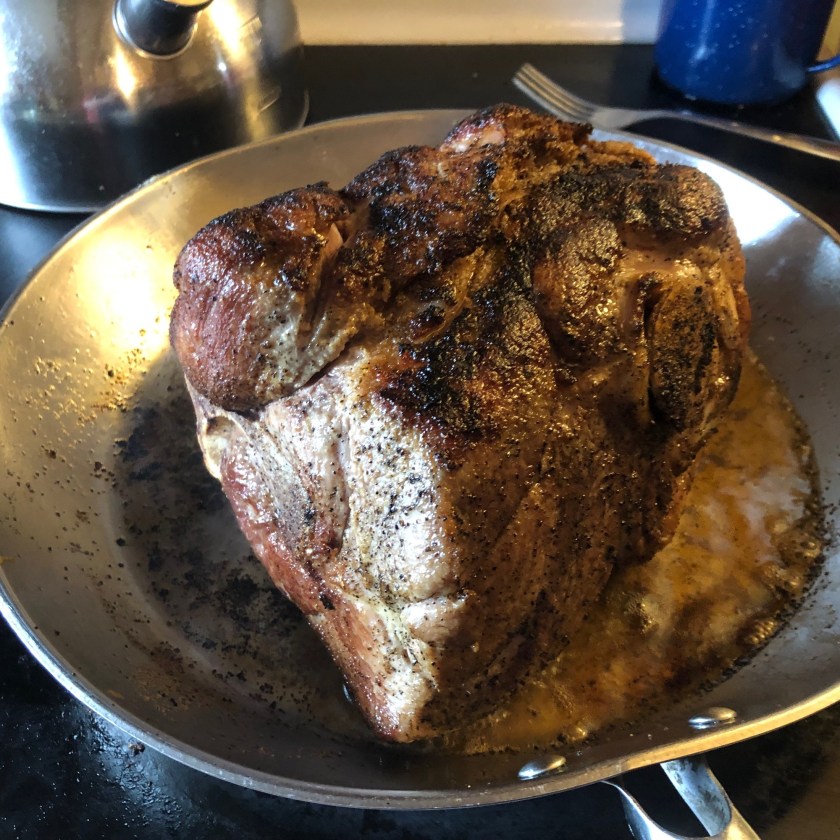
There was leftover ham from last week when we had wall to wall ham. I seared up a nice pork butt with plenty of seasoning in a pan, and then roasted it slowly for several hours.

Then I sliced it and and piled up those sandwiches pretty good. Mustard, Swiss cheese, ham, pickles, pork, more Swiss cheese, more mustard. I used Italian bread, and fried them in lots of butter, and we had pineapple on the side. 

Corrie was desperate to help, so I told her to put a piece of ham on every sandwich. And that is what she did. 

You are supposed to press these sandwiches, but when it came down to it, I just didn’t feel like it. What I did feel like was taunting Pascal Emmanuel Gobry, who hadn’t eaten for many hours, with photos of my sandwiches on Twitter. Honest to goodness, I’ll be the last one left in purgatory, because I just had to taunt Pascal Emmanuel Gobry with photos of Cuban sandwiches on Twitter. 

TUESDAY
Strawberry chicken salad

Nice and easy. Greens, sliced strawberries, toasted almonds, and chicken with balsamic vinegar. We also had some leftover Chinese noodles that added an extra crunch along with the almonds. I forgot the feta cheese, but we survived. 

I was afraid I hadn’t bought enough chicken, so I made some quick banana muffins. These really are the quickest of muffins, and foolproof. Recipe card at end. 

WEDNESDAY
Pasta primavera

I happen to love this dish. The broccoli had gone bad, but I had plenty of other vegetables, having been swept up in a primavera enthusiasm while I was shopping.

I ended up with carrots, red onions, asparagus tips (just the tips! I SO FANCY!), green peppers, zucchini, mushrooms, and snap peas, and the sauce was just lovely, with plenty of onions and garlic and butter, chicken broth and white wine, cream, pepper, and parmesan. Some people put tomatoes in this dish, and that would also be nice.

I wish I had chosen some other pasta besides spaghetti, to grab up more sauce, and I wish I had used less pasta for the amount of sauce I made, but it was still a filling and pleasant meal, creamy, a little sweet, with plenty of snappy veggies. 

Of course we made plain spaghetti and served it with the leftover ravioli sauce. I think exactly one kid even tried the primavera. 

And this goes out to Miss Ellis:

At last comes the primavera, ai, primavera, ai, primavera, ai ai!
The deep winter snows are melting high in the sierra, high in the sierra.
(Something something something);
Blue skies are showing;
Through the empty arroyos
New streams are flowing,
New streams are flowing.
 

Recipe card at the end. And I am incapable of typing out “primavera” on the first try. It always comes out “primavery,” which makes me Yosemite Sam. Have a cee-gar with your primavery!

THURSDAY
Lemon pepper pork, pepper, and onions; yogurt sauce and pita; za’atar rice with ca’arots

I didn’t have a clear idea about this meal, so I just wung it.

For the rice, I made plain rice in the Instant Pot. Then I shredded some carrots and sautéed them in olive oil with some za’atar and red pepper flakes. Then I added in some of the rice, then some more za’atar, and heated it through. I really don’t think you can call this pilaf in any way, but I guess that’s what I was aiming for. It was okay. Yogurt sauce helped a lot; and it did make a decent, warm-tasting accompaniment for the meat and vegetables, which had a sharper flavor. 

I cut up plenty of red onions and green peppers into chunks and mixed them up with chunks of pork and sliced zucchini, then dressed it all with olive oil, lemon juice, and plenty of lemon pepper seasoning. I spread it in a shallow pan and shoved it under the broiler until it was a little charred.

Then we had yogurt sauce (Greek yogurt with minced garlic, pepper, a little salt, and lemon juice) and pita. It wasn’t a completely smashing meal, but it worked well enough, and it sure was fast to put together. 

Oh, about the zucchini. I’m not a fan. I know I served it twice this week, but that’s just because I bought a lot of it. Why I bought a lot of it, I don’t know. Anyway, lemon pepper zucchini in garlicky yogurt sauce? Is so tasty. I may make a dish of just that in the future. 

FRIDAY
I honestly don’t know. I thought something would have come to me by now. ¡Ai ai!

Lime Crema

Keyword Budget Bytes, crema, lime, lime crema, sour cream, tacos

Ingredients

  • 16 oz sour cream
  • 3 limes zested and juiced
  • 2 Tbsp minced garlic
  • 1/2 tsp salt

Instructions

  1. Mix all ingredients together. 

Recipe Notes

So good on tacos and tortilla chips Looking forward to having it on tortilla soup, enchiladas, MAYBE BAKED POTATOES, I DON'T EVEN KNOW.

Banana muffins (or bread)

Makes two loaves or 24 muffins. Quick, easy, and pleasant. 

Ingredients

  • 6-7 medium ripe bananas
  • 4 eggs
  • 4 cups flour
  • 1.5 cups sugar
  • 2 tsp salt
  • 2 tsp baking soda
  • 1.5 cups chopped nuts (optional)
  • 2 tsp cinnamon (optional)

Instructions

  1. Preheat oven to 350. Butter loaf pans or muffin tins, or use cupcake papers.

  2. Mash the bananas in a bowl. Beat the eggs and blend the into the bananas. 

  3. In another bowl, mix together all the dry ingredients. Add the dry mixture to the banana mixture and stir just until blended. Stir in nuts if desired. 

  4. Pour batter into pans or tins. Bake about 28 minutes for muffins, about 1 hour for loaves. 

Yogurt sauce

Ingredients

  • 32 oz full fat Greek yogurt
  • 5 cloves garlic, crushed
  • 1/4 cup lemon juice
  • 3 Tbsp olive oil
  • 1 tsp salt
  • 1/2 tsp pepper
  • fresh parsley or dill, chopped (optional)

Instructions

  1. Mix all ingredients together. Use for spreading on grilled meats, dipping pita or vegetables, etc. 

Pasta Primavera

Pasta in a pleasant cream sauce with an assortment of snappy vegetables. You can use whatever vegetables you like, really. 

Ingredients

  • 2 lbs cooked pasta
  • 4 carrots, sliced into thin discs
  • 1 green pepper in short spears
  • 1 zucchini, skin on, sliced thinly
  • 12 oz mushrooms, sliced
  • 1 lb asparagus, chopped (or asparagus tips)
  • olive oil
  • 4 Tbsp butter
  • 1 cup half and half or cream
  • 1/2 cup white wine
  • 1 cup grated parmesan
  • 8 cloves garlic, minced
  • 1 med onion, diced
  • handful peas or snow pea pods, chopped
  • 1 cup chicken broth

Instructions

  1. Heat the olive oil in a large skillet. Cook the carrots and peppers until slightly soft. Remove the veg and set aside. 

  2. Add the butter and a little more oil to the skillet. When the butter is melted, add the mushrooms, zucchini, and asparagus. Cook until slightly soft. Remove veg and set aside. 

  3. Add garlic and onions to skillet. Cook until slightly soft. 

  4. Add chicken broth and wine, and cook, stirring, until it reduces to about half. 

  5. Add cream and parmesan and stir to blend. Add salt and pepper to taste. 

  6. Add all the vegetables back into the skillet. Add the raw peas. 

  7. Put the cooked pasta in a bowl, add the sauce and vegetables, and combine. 

In praise of Mike Mulligan

My friends on social media often share excerpts from books they are reading: Illuminating passages from encyclicals, breathtaking ideas found in scholarly books about design and sociology.

I, on the other hand, post a little bit of Mike Mulligan and His Steam Shovel:

I shared this after reading it aloud for maybe the eight thousandth time the other day. I was admiring once again the perfectly-crafted rhythm of the story. You would have to work really hard to read it wrong. In the page I shared, you can hear the building, busy excitement as more and more people get caught up in the action:

“Now the girl who answers the telephone called up the next towns of BANGerville and BOPperville and KIPperville and KOPperville and TOLD them what was HAPpening in POPperville.

“All the people came over to see if Mike Mulligan and his steam shovel could dig the cellar in . . . ”

and the sentence ends in three, flat, one-syllable words that land with incredulity:

“just. one. day.”

The author, Virgina Lee Burton, would read her books aloud to her own two sons and to neighbor children, to make sure they liked it. She said:

My first book, Jonnifer Lint, was about a piece of dust. I and my friends thought it was very clever but thirteen publishers disagreed with us and when I finally got the manuscript back and read it to Aris, age three and a half, he went to sleep before I could even finish it. That taught me a lesson and from then on I worked with and for my audience, my own children. I would tell them the story over and over, watching their reaction and adjusting to their interest or lack of interest . . . the same with the drawings. Children are very frank critics.

This is about the story, characters, and pictures, but also about the sound of the writing itself. When you’re reading aloud, a book is only as good as how well it can be read. An awful lot of modern children’s books have all the elements that people think kids want: zaniness, lots of frenetic action, lots of repetition; but they require the reader to make constant adjustments so the lines come out right. 

The execrable Skippyjon Jones books come to mind. They are hugely difficult to read aloud, because the words stutter and start and pile up, but rather than building excitement, they’re formless and aimless, littered with dreary puns that kids won’t get, lacking any purpose or arc. They always remind me of this clown, Cheryl, who used to turn up at children’s events. Her entire repertoire was screaming at the kids, because she heard kids like screaming, so here is some screaming. Cheryl was exhausting.

Anyway, about the story of Mike Mulligan. I was astonished to find that some people think it’s depressing. To paraphrase what several people said: He messes up one little job, and now he has to be a janitor forever! Mary Anne is interred in a basement for the rest of her life! I guess if I read the book for the first time as an adult — especially, perhaps, as a young housewife feeling overlooked and trapped — I might read it that way. 

But I did grow up loving the book, and so I’m predisposed to seeing more in it. It’s a John Henry story (“He always said that she could dig as much in a day as a hundred men could dig in a week but he had never been quite sure that this was true”);  except instead of a glorious death in the end, Mrs. McGillicuddy takes them nice hot apple pies. The end of the story is no dark tomb; sunlight pours into the basement, a sort of Elysian Fields for heroes who have earned their rest. 

Several of Burton’s books deal with the idea that progress is good, until it stops being good. (Her excellent The Little House is a more stark and melancholy story with the same theme.) Mike Mulligan and Mary Anne are a victim of their own success. In their prime, they did all the works of progress: They dug the great canals, they cut through the high mountains, they lowered the hills and straightened the curves.

They were literally on the cutting edge of industry and progress; and that means they were destined to be surpassed. 

What are they to do? In a briefly grim passage, Mike has a vision of Gehenna:

It’s intolerable. But where else can you go, when you’ve come to the end?

But in Virginia Lee Burton books, there is always a way out; always a little bit of paradise still reserved for the worthy. So the two heroes set off for greener pastures

and Mike finally has the chance to find out if he and Mary Anne can really dig as much in a day as a hundred men could dig in a week. 

The busy pressure of their past life of industry is recreated in one final, intense day of crisis: He and Mary Anne are fighting against time. The era is coming to an end; the sun is going down. The only way to survive is to do what they are made to do, faster and faster.

And they win! They beat the sun. But in their victory, they have literally dug a hole for themselves that they can’t get out of.

And here is the brilliance of the book. How are they going to get out? It’s not just about this specific job; it’s about retaining their dignity and identity in a changing world. They’ve come to the end. What can be next?

It would make no sense for them to find more and more digging to do. They’re no longer wanted in the city, but they also can’t despoil the green and sunny world that saved their lives. So instead, rather than finding a way out, they find a way to stay in . . . but without defeat.

Mary Anne’s engine keeps working, but now she warms up the meetings at the new town hall. It’s the end of an era, and this is inescapable; but that doesn’t mean anyone is consigned to the netherworld. They lay down their hammer, but they do not die.

Not to put too fine a point on it, but Mike and Mary Anne’s virtues are transformed into warmth, rather than mere industry. (They always worked better and faster when people are watching, after all.)

And through their ordeal, Henry B. Swap, with small town scheming ways, is also transformed; and after Mike triumphs, “he spends most of his time in the cellar of the new town hall listening to the stories that Mike Mulligan has to tell and smiling in a way that isn’t mean at all.” So it turns out it’s all about people, in the end.

There are other children’s books that look back fondly on the past, but I’ve never found another book that deals with inevitable change in such a satisfying way.

But it’s not a lesson book, a wholesome moral disguised as a story; and that’s another of Burton’s virtues. My four-year-old doesn’t hear a Fin de siècle rumination on identity, mortality, and the mixed blessing of productivity. She hears an exciting story about digging, and billowing clouds of dust, and hurry hurry hurry, and Kipperville and Kopperville and Bangerville and Bopperville, and hot apple pies, and that’s what makes it a good book. 

So I guess I’m okay with being the one who gets all excited about children’s books, enough to share passages that I find illuminating. I know full well that some people see my kind of life as interred in a basement, endlessly changing diapers and wiping up crumbs instead of using my mind and my college degree and making constant progress. What can I say? I’m using the engine I have, and I feel like I’m making some warmth.

Prolife spotlight: St. Joseph’s House and Isaiah’s Promise offer support, respite, and joy to families of the disabled

Cubby LaHood used the term “D-day” for the day parents first hear their unborn child has a severe or fatal birth defect.  

“The baby is the same baby they conceived and were joyful about, but … the baby can become a stranger,” she said in a 2013 40 Days for Life address.

LaHood, who died in 2015, suffered the same crushing shock herself, when her baby Francis got a likely fatal prenatal diagnosis. Everyone offered the couple abortion — doctors, clergy, family, and friends. But she and her husband Dan decided that they would love and carry their son Francis as long as he lived.

 
The LaHoods firmly believed unborn children with severe or fatal diagnoses deserve to live. But they also came to understand that carrying such children to term, rather than resorting to abortion, can bring healing, strength, and even joy to the parents and family, and even to the rest of the community, whether the child dies before he is born, or if he goes on to live for several years. 
 
“Hope led to grace, grace led to faith, and faith led to peace,” she said. 
 
Cubby and Dan LaHood went on to found two organizations based in Maryland, to offer encouragement, resources, and tangible support to people with disabilities and their families. Isaiah’s House, founded in 1995, offers personal support for families carrying to term after a severe or fatal prenatal diagnosis.
 
“In seemingly the most hopeless and difficult of circumstances surrounding the birth of a child, a simple ‘yes’ to life reveals the presence of God, and the presence of love,” she said in a video called “Destined to Live Forever.”  
 
They believe that even a very short life has meaning and power. “[These parents] conceived a miracle, and that miracle deserves all the support that you can give it. It’s about more than you,” LaHood said. 
 
Pro-lifers are frequently accused of being merely pro-birth, of counseling parents to reject abortion, but then abandoning them after the delivery. The LaHoods’ mission refutes this accusation. The other organization they founded, St. Joseph’s House, offers daycare, summer camp, and after-school programs, and respite programs for families of children with disabilities.
This effort, too, sprung out of a personal experience. When Cubby LaHood was pregnant with her first child, she wanted to stay at home, so she decided to open a daycare. The first client she found had a disability, and word quickly spread that LaHood was willing to care for disabled children. 
The family soon made it their mission to make a true home for these children, and to counter “the eugenic impulse” of the world that wants to reject anyone deemed imperfect or useless. St. Joseph’s House is now run by the LaHood’s daughter, Natalie. 
 
Cubby LaHood didn’t believe her family was special. “We all have the capacity to give love,” said LaHood. “It can be done without support — we did it without support — but there’s no reason for it to be done that way.”
 
 The LaHoods do not minimize or sentimentalize the difficulty of carrying and caring for a child with disabilities.
 

“Nobody wants to go through the Passion,” said Dan LaHood “No one wants to go through the Garden of Gethsemane. But once you go through it, you find there’s the spirit of God. There’s resurrection. Not only there’s life, but it’s eternal, and it’s more than you could ever imagine; and you can experience it now.”

None of the hundreds of couples they’ve walked with have regretted their choice, the LaHoods said. 

“Even in this worst, most darkened, most rejected place, God is. Love is.”

***


Image from this video:

Destined to Live Forever from Lumen Catechetical Consultants on Vimeo.

St. Joseph’s House

​Saintjosephshouse1983@gmail.com

On Facebook: https://www.facebook.com/saintjosephshouse/

Isaiah’s Promise

info@isaiahspromise.net

On Facebook: https://www.facebook.com/IsaiahsPromise4915/

St. Joseph’s Place also runs Cafe St. Joe in , “part job skills training, part community builder, and part fundraiser.” The Cafe offers a specialty blend of coffee made by a roaster that employs adults with disabilities, and half the proceeds to go the cafe

***

Previous volumes of Pro-life Spotlight:

We Dignify

Gadbois mission trip to Bulgarian orphanage

Mary’s Shelter in VA

China Little Flower

Immigrant Families Together

Rio Grande Valley Catholic Charities Humanitarian Respite Center

If you know or have worked with an organization that works to build a culture that cherishes human life, please drop me a line at simchafisher at gmail dot com with “pro-life spotlight” in the title.

Today I’m on The Catholic Podcast . . .

talking with Joe Heschmeyer and Chloe Langr about Mary, Our Lady of Sorrows, for their series on the way of the cross. This episode, #57, is called “The Women of the Way,” and includes passages by the great Josef Ratzinger.

You can hear and download the episode here.

I talk about how I came to understand why and how Mary truly understands our suffering; and about the sensation of helplessness that so often comes along with motherhood and with love in general, and how that sensation can either tear us away from God or help us meet him more intimately. (This conversation was the impetus for my essay, Mary who stays.)

Their other guest is Deacon Brad Sloan who works with women who’ve been caught up in sex trafficking in the midwest. He says so many of them have never experienced what it means to be loved, by anyone else and certainly not by their maker.

The podcast isn’t just discussion; it’s intended to help you meditate on various themes in the stations of the cross. The goal is to help us understand that we’re not alone in our suffering, and to give us the courage to confront evil in our lives. 

The Catholic Podcast homepage is here and feed is here; and you can follow them on Facebook @TheCatholicPodcast.

Image: Station of the cross, Saint Symphorian church of Pfettisheim, Bas-Rhin, France. XIXth century. Detail of the 4thstation : Jesus and his mother. Photo by Pethrus [CC BY-SA 3.0 (https://creativecommons.org/licenses/by-sa/3.0)]