The delightful Claire Swinarski graciously invited me to be on her podcast, The Catholic Feminist. My episode, #50, is up today. It was so refreshing to talk to a young Catholic woman who both loves the Faith and isn’t allergic to the word “feminist.”
Among other topics, we talked about “#metoo,” about why Damien and I covered the Christendom story, how virginity culture objectifies people, how to teach consent so it dovetails with a Catholic understanding of human dignity, and how to come back to Christ after the Church has failed you. You can hear the podcast on The Catholic Feminist Podcast site, or listen to it right here:
Imagine you’re a college campus minister, and you’re also the mom of two young kids, both with special needs, who each have “specialists up the wazoo.”
Imagine you live out in the country in New Hampshire, with only your chickens and your vegetable gardens for company as you boil sap for maple syrup and research the ins and outs of farming hops. Your husband is in the military, and you’re waiting to hear if you’ve been accepted to a Ph.D program at the University of Aberdeen. And you have your eye on some goats, and maybe beehives.
These are thoughtfully composed knitting kits designed as gifts “for anyone who needs something to keep their hands full while their heart is on the mend.”
Cheshire received a similar gift herself several years ago, after enduring the traumatic birth of her first child in Juneau, Alaska. The newborn was airlifted to another hospital, and Cheshire was too weak to join her for several days. Then followed a time in the NICU that she describes as “brutal, brutal.”
A friend gave her some knitting materials and instructions, with the note: “You need something to keep your hands full until you can hold your baby.”
That idea of full hands remained with her, and now she’s offering it to other people, hoping to share some healing while helping to build connections between people.
People don’t know what to say, so they say nothing
Since Cheshire works with college students, I asked if she thought it was mainly modern people who struggle to come up with appropriate words. She does believe modern people have trouble sharing “deep, authentic communication,” and that pervasive social media can make human interaction superficial; but she’s defensive of millennials. In the past, she said, there was no internet, but people were not necessarily warmer or more connected.
“I know some 65-year-olds who don’t know how to relate,” Cheshire said. “Very often, people don’t know what to say, so they don’t say anything. The tragedy is, that happens when their friend really needs them to say something.”
A beautiful experience
Each element of the Busy Hands Boxes is chosen with care.
“Anyone can go to Michael’s and get cheap yarn,” Cheshire said. “I wanted it to be something that had heart at every level. Something sourced from a company that cares, something aesthetically pleasing, and beautiful to open. I wanted it to be a whole experience, to make you feel good even if you’re not knitting yet.”
The hand-painted knitting needles are made from New England maple and Russian birch.
Like the needles, the wool yarn Cheshire chose is locally sourced from Peace Fleece, a New England fiber company that “works to support pastoral communities that have been historically in conflict with the U.S.”
They are currently blending domestic wool and mohair with Navajo Rambouillet, which has been purchased at fair market prices from families living on the reservation.
Then there’s the slightly cheeky “empathy cards” from Emily McDowell , which bear messages like “I promise never to refer to your illness as a ‘journey’ unless someone takes you on a cruise” and “Please let me be the first to punch the next person who tells you everything happens for a reason.” One Full Hands box includes a foil card featuring a medal that simply reads, “KEPT GOING.”
Cheshire heads out to the barn
Value in particularity
For Cheshire, a natural introvert who spends much of her day in pastoral work, knitting is often how she keeps going. “I need alone time, or I go crazy,” she said.
One of Cindy’s cats also enjoys solitude – photo courtesy Cindy Cheshire
After a series of stressful meetings at work, she’ll often find a quiet corner and knit for five or ten minutes. “Knitting gives me something to do in that space, to clear my head.”
She also knitted her way through a batch of nervous energy while she waited for a response to her dissertation research proposal. The topic? Identity Formation in Pauline Communities.
Cheshire says she wants to use the baptismal formula used in Galatians, Colossians, and Corinthians “as a case study to see how those communities might have understood identity, on a community and on a corporate level.”
She says, “When we read there is ‘no slave, no male, no female,’ we mostly use it as a kind of whitewashing. It doesn’t matter, we’re all one in Jesus! Everyone’s one!”
But this kind of thinking, she said, can make it easy to ignore how identity categories are actually hurting people in the congregation.
“It just perpetuates power cycles,” she says. “People in charge continue to be in charge, and they don’t have to look at other people’s experiences. But everyone has value in their own particularity.”
What do you want to do with your time?
I asked Cheshire if focusing on that particularity isn’t something of a burden for her, an already extremely busy introvert whose mission it is to foster personal, intimate connections in her work on campus.
She thought for a while, then listed all the many responsibilities she juggles. She noted that when people ask her how she does it all, she tells them she’s not doing as good a job as they think she is.
Cheshire’s daughter, wanting to join in the interview, writes up a marketing blurb for her mom’s shop
But also, she said, “God has made this situation into something good. He’s forced me and my husband to figure out something about ourselves. What’s non-negotiable? What do you really want to be doing with your time? Because you don’t have that much of it.”
Although she and her husband have no background in farming, they’re slowly learning.
“It’s a little difficult to really engage in care for creation when you’re surrounded by concrete.” she said. She’d rather work the land than support industries that exploit workers and contaminate the soil.
Some of the fruits of Bethany Farm – photo courtesy Cindy Cheshire
Their first harvests have been small, but encouraging, and they’re hoping to add berry bushes and fruit trees in the future. Of their harvests, the Cheshires save some, sell some, and give some to the food pantry. Cheshire was recently overjoyed to hear that, after she donated fresh eggs, one client was able to make brownies for the first time in ages.
“In my career,” Cheshire said, “I’ve gotten very comfortable with the fact that I rarely see the harvest. My entire job is to plant seeds and let God grow them, and maybe a few years down the line I’ll get a text message or an email from a former student saying how much their time at Newman meant to them.”
But establishing a farm gives her “something very solid to hold onto.”
Eggs from Bethany Farm chickens – photo courtesy Cindy Cheshire
Spiritual health is a real thing
One professional project she’s chosen is to reignite an interest in the spiritual life among apathetic college students. Very few students feel any kind of religious affiliation, she said, and the ones who consider themselves Catholic aren’t much interested in community; so she’s working on reformulating her approach.
“You can’t convince people to enrich their Catholic identity if they don’t see the value of spirituality to begin with,” she said. She had been warned that the campus was an anti-religious place, but is proud of the connections she’s made. She collaborates often with other groups, and sponsors “crafternoons” where students can work off some nervous energy of their own, making and building together.
“We’re trying to encourage the campus community to tend to their spiritual health, to realize that’s a real thing, just like their physical and emotional health.”
Cheshire is currently working her way through the spiritual exercises of St. Ignatius, which, she said, are about “finding the dignity of everything, finding God in everything.”
One of the Cheshire flock – photo courtesy Cindy Cheshire
I asked whether even knitting was part of that.
She said, “I love watching the process of turning a pile of string into something beautiful. It’s something that’s real, and something that’s very elemental. It’s the absolute opposite of digital, and it connects you to all these generations of people who have done this before.”
Cheshire said knitting forces her to notice and intentionally relax the tension she holds in her hands. She was recently contemplating the hidden years of Christ, before He began His public ministry. The takeaway, she said, was Christ saying, “Remember, I was an artisan, too.”
chalkboard wall in the Cheshire kitchen – photo courtesy Cindy Cheshire
Why the name, “Bethany Farm Knits?” Her shop, and her five-acre farm, are named after Bethlehem Farm in West Virginia. It’s a family of intentional Catholic communities, where Cheshire has led mission trips with the students from the Newman Center. The farms are named after Biblical towns, and the Cheshires chose “Bethany” for theirs.
She said ,”It’s where Jesus experienced friendship and hospitality” with His friends Mary and Martha — and also resurrection, when He raised their brother Lazarus from the dead.
“Those things are very much a theme in our family life,” Cheshire said: “Hospitality and resurrection.”
They say that God never answers “no” to a prayer. His only answers are “yes,” “not yet” or “something better.” I believe this, in theory, but in practice, “not yet” feels much worse than you would expect. You understand the justification for waiting: If we force events that are not ready, things may go terribly wrong, and who will be there to save you then?
But that does not make the pain any less. There is no escape. You still have to labor the long way.
Almost any time I’m writing, I’m writing with kids around.
A lot of what I publish, including this post, is hasty and unpolished, so I feel a little weird about giving writing advice. Nevertheless, I do produce about 3,500 to 5,500 words most weeks, whether I feel like it or not, and most of that is done while I’m the only adult in a house with one or more little kids; so I guess I have something to say about writing through distractions.
Full disclosure: I do most of my writing while I’m alone with a toddler, but some amount of writing when I have older kids in the house who can help with the younger kids. Moms of only young kids: It does get easier!
Here are some details of how writing gets done around here. These are in no particular order, because it’s vacation week, my kids are fighting over the Spirograph and repeatedly shrieking the “la la la la laaaa” part of “Crocodile Rock,” and it’s vacation week, and they are shrieking. I have bolded some parts to make it look organized.
Don’t expect to sit down and write something start-to-finish. Most often, I get an idea while I’m driving or at Mass or shopping, and I’ll write down a few notes on a receipt, or email it to myself. I usually know when I’m next going to have a block of time to write, so I keep my thoughts about it simmering, and the rest of the essay is often halfway written before I even sit down. I haven’t always been able to do this. It used to be that, if I didn’t immediately pin down an idea, it was gone. Keeping an idea for later is a skill you can cultivate with practice.
Always be writing, even if you’re not writing. Being a writer means you always have some aspect of the project going on, even if that’s just looking around for inspiration, mulling over what you’ve already written, talking an idea over with someone, or wondering why some phrase from Moby Dick keeps popping up in your head every time “Chiquitita” comes on the radio. (There is no joke here. It just seems like something that would happen.)
Yes, set aside specific writing time. Most often, I write for two hours (or more) in the morning, and that’s when I get the biggest chunk of writing done. The easiest way to make this happen is to let the toddler watch TV, and that is often what we do. It’s not ideal, but it’s not the end of the world. The longest I can stand to let the kids watch TV is about as long as I can stand to write without taking a break, so that works out. I try not to let one kid watch TV alone. I can live with two kids watching TV together without me, though.
Get something done. If I spend an honest hour or more trying to write and I’m just not making any headway, I will often slap my laptop shut and throw myself wholeheartedly into something else productive, like cooking dinner ahead of time or getting caught up on some housework I was planning to do later. Discouragement snowballs quickly, and if you can’t write but also can’t get anything else done, you’ll finish up the day feeling useless, and tomorrow will be even harder. So make a good try, and if you can’t write, get something done. Sure, it would be more healthy to sternly remind the yawning void that you have intrinsic value even if you don’t produce anything, but sometimes it’s easier just to work with the void.
Write in ridiculous times and places because life is ridiculous. I write while they are in the bath (I sit on a cooler. It’s much more comfortable that typing on the toilet).
In warm months, I write outside while they play, but this one is tough, as they want a lot of engagement, and it’s hard to find enough shade to see the screen properly.
I write on the couch while they climb back and forth across the back of my neck, and I write while I nurse.
I write when I wake up very early and can’t get back to sleep (most of my book was written and edited between the hours of 2 and 6 a.m.).
I write squirreled away in my bedroom while big kids are home to watch little kids or while my husband is home to wrangle kids and make them fold laundry.
I write in the dentist’s waiting room and in the car while I’m waiting to pick people up from the library or Girl Scouts or Shakespeare Club. Sometimes I write while I’m cooking supper, so I can give them two reasons to feel guilty for interrupting me (which they don’t).
Expect and embrace interruptions (well, up to a point). If you’re writing at home with kids around, there will be interruptions. I have worked on getting the kids to take it seriously when I’m typing — to understand that Mama is working a real job just like Daddy works a real job; and that, when Mama is typing, that means Mama is talking, and I’m not available until my hands are still.
But still, if I am home, I am their mother, and I don’t want to be 100% off limits unless I have an especially stressful deadline. So if it’s extremely important that I not be interrupted, I will be very clear that I need to be left alone for x amount of time. If I’m just plodding through something, though, I’ll leave my door open or write in the kitchen, so they can find me if they have a really, really important banana joke or something.
I also have deliberately cultivated the ability to put a bookmark in my thoughts so I can take care of an interruption and then get back to writing. I have also cultivated the ability to grimly push ahead with writing while ignoring howls, kicks, messes, and bids for attention.
It’s actually useful to have to come back to an essay more than once. Think of those interruptions as a chance to freshen up your perspective, so when you come back to an essay, you can read it more objectively. Quiet, void! This is totally a thing!
Wanting to write does not make you a bad mother. Other mothers in other generations haven’t felt the deep, urgent, guilty need to be available to their kids at every moment. The work I do is real work, and it’s normal and reasonable to feel frustrated at interruptions. At the same time, I don’t want my kids to feel guilty or afraid of talking to me if they need something. So I constantly reassess how much time I am spending with them, what I do with my time, what my tone is when I do respond to them, and so on.
But it’s not horrible for them to know that they’re not the center of the universe, and it’s not horrible for them to see their mother doing something other than childcare, cooking, and cleaning.
Just as with nutrition, I don’t stress out about getting the balance right hour to hour or even day to day. Throughout the course of the week, though, I do try to make corrections if I feel guilty night after night about not spending enough time with the kids.
Accept that writing takes time, and that time will be subtracted from your day. It sounds silly, but many mothers believe they can sort of sneak writing in around the edges while taking care of everything else at the same level as when they’re not writing. This is crazy. If you’re spending time writing, you’re not spending time on something else, so that something else won’t get done. You have to decide what’s more important to get done, writing or the other thing, and that’s all there is to it.
Someone asked J. K. Rowling how she managed to write a series of bestselling books while raising a baby alone, and she said, “I didn’t do housework for four years! I’m not Superwoman, and living in squalor, that was the answer.” Sometimes I look at how squalid my house is, and I think, “Damn, I better do some better writing, to justify this.” Either that, or write up a few cheap listicles and then go scrub the shower.
Power through the troughs. There are times when I sit down to my computer like a cat with six different mice to chase, and I just can’t decide which one looks the tastiest. And there are times when the alphabet looks soggy and unfamiliar, and I have a hard time fighting my way all the way through a sentence until I reach the predicate. You’d think I’d write better when I’m refreshed, rested, and feeling upbeat and optimistic, and that it would be harder to write in times of extreme exhaustion, but in fact it doesn’t have anything to do with anything.
Every single writer I have ever talked to goes through this crap sometimes. It’s horrible. It will make you think you’re on your way to EOBD (Early Onset Brain Death), and whatever success you’ve had in the past was just some combination of luck and trickery, and now you’re done, just done, and everyone has been laughing at you for years.
Keep writing anyway, bucko. Eventually that fickle muse will find her way back to your shoulder, so you better be already in the habit of working when she does.
There is one consolation to writing when you feel zero inspiration, and that is to remind yourself that you’re not struggling, you’re in training. Every time you finish an essay without the aid of delight, you’ve completed another round of training for when delight in writing returns (and it will return). Every time you force yourself to express something you don’t care much about because life is meaningless and whatnot, you’ll find your mind that much more agile and responsive when the ideas again come waltzing up one after another, begging for a dance. Tra la la!
Husband. Back when I was writing for my rinky dink little Blogspot blog with twenty-seven readers, my husband saw that it was important for my mental health, and didn’t make me feel bad for spending time writing almost every day, even when there wasn’t even the hint of getting paid for it. Without him making time and space for me to write, and without him reassuring me that it was important to him because it was important to me, I would probably have scrapped it years ago. So now you know whose fault it is that I keep cranking it out! If you don’t have a husband like this, see if you can find a friend who will reassure you that you’re good, and believe them, dammit.
It may just be that you can’t all the writing you want to do right now. There are just too many other things going on. Kids too needy, obligations too pressing, sleep too not-having-enough. I firmly believe that writers will always find a way to write, somehow. It’s a sickness. It’s a compulsion. It’s a thing that will fight its way back up to the surface when the time is right. Writers gonna write, so if you’re a writer, you will find yourself writing. Right?
When I was an adolescent, our Catholic girl’s group made a large batch of cards for the residents of a nursing home. “YOU ARE LOVED,” we spelled out over and over again, switching to scented markers when we got bored. We added a few stickers, then we threw all the cards in a bag to be delivered, and we got back to our real lives.
I felt obscurely ashamed and angry at the disingenuousness of this exercise, thinking how little it would mean to some ailing old woman to get a card from a girl she never met. Or, I thought, maybe it would mean a lot, and that would be even worse. “You [whoever you are] ought to feel loved [passive voice] by someone who couldn’t even be bothered to sign her name, because she has field hockey now [smiling sun sticker].” How worthless. Worse than no card at all.
But it never occurred to me to fix it by being sincere — by actually showing actual love to actual people, spending time with a lonely stranger. I didn’t want to do that, either. So I scrapped the whole thing.
I felt something of the same angry distaste when I was little and would occasionally watch Mr. Rogers at my grandparents’ house. My sister and I thought he was unbearably goony (and it didn’t help that I was secretly terrified of Lady Elaine). When his show came on, we would elaborately die of boredom, rolling our eyes so hard, we could see the inside of our snarky little skulls.
But I also didn’t like how he was always talking directly to me. You don’t know me! You’re just on TV! You don’t even know if I’m watching or not, so why are you pretending you care about me? I pretended to be bored, but I was also truly angry.
There was something more, though. I couldn’t deal with his face. I just didn’t want to look at it. He had that smile of extreme simplicity that you see in people who have gone through tremendous sorrows, or in the mentally impaired at Mass. It’s a radical openness, a lantern that burns too bright.
Looking at his face now, fifty years after his first show aired, I think that I was very wrong about this man’s sincerity.
Mr. Rogers was remembered by François Clemmons on StoryCorps a few years ago. (The very short StoryCorps features on National Public Radio are almost always worth a listen — sort of the audio equivalent of Humans of New York.) In this edition, Clemmons tells how Fred Rogers invited him to come play a policeman on his show.
“I grew up in the ghetto. I did not have a positive opinion of police officers. Policemen were siccing police dogs and water hoses on people,” he says. “And I really had a hard time putting myself in that role. So I was not excited about being Officer Clemmons at all.”
But he agreed; and one show in particular stands out in his mind. It was 1969.
Rogers had been resting his feet in a plastic pool on a hot day.
“He invited me to come over and to rest my feet in the water with him,” Clemmons recalls. “The icon Fred Rogers not only was showing my brown skin in the tub with his white skin as two friends, but as I was getting out of that tub, he was helping me dry my feet.”
Something to think about during Lent, as Holy Thursday approaches.
Fred Rogers clearly saw his career as an opportunity to invite, to serve, and to model charity. When he dried Clemmons’ feet, he wasn’t only doing it for the cameras — although that in itself was a momentous statement in 1969. He wasn’t merely modelling charity; he was being charitable, personally, to the actual person beside him.
Rogers didn’t hide behind the TV screen and consider that he had discharged his duty by broadcasting his message to the millions of people who watched his show. Talking to a crowd was not a substitute for talking to the man in front of him. Writers and social media warriors, take heed: There is no substitute for the personal.
[Clemmons] says he’ll never forget the day Rogers wrapped up the program, as he always did, by hanging up his sweater and saying, “You make every day a special day just by being you, and I like you just the way you are.” This time in particular, Rogers had been looking right at Clemmons, and after they wrapped, he walked over.
Clemmons asked him, “Fred, were you talking to me?”
“Yes, I have been talking to you for years,” Rogers said, as Clemmons recalls. “But you heard me today.”
Okay, so, that sounds familiar. Doesn’t it? Who talks that way? You know who. That’s why I still find it hard to look Fred Rogers in the face. He was a holy man.
Flu season isn’t just uncomfortable, it’s expensive. In your quest to find some physical relief, you’ll end up paying through the nose for medicine and remedies. And your nose is already busy sneezing! Isn’t there anything you can do to alleviate the fiscal pain, if not the physical?
No; but let’s pretend there is for a second. Here are some tips:
Create a barrier. The flu is transmitted through tiny droplets that are airborne, so you can contract the virus simply by breathing in a space where an infected person has coughed or sneezed. So, like, Earth. Your only recourse is to make a barrier. Try taking a cotton swab and carefully lining your nostrils with super glue. Pinch delicately. For added protection, do the same for your lips. Also your eyelids and your ears. Feel better yet? What?
Clean your bathtub. Yes, right now. Use one of those “clinging foam” cleansers, preferably one known to the state of California to cause cancer, birth defects, and a profound sense of the cold robbies. Do not open windows. Do as many jumping jacks as possible, and then stand there panting and wheezing and drawing those healthful bleach molecules into your mucus membranes and lungs. Cleans you right out from the inside, where it counts.
Remember the dignity of your orifice. Find a hole, cram something in. Make new holes if necessary. I’m not kidding: warm oregano oil in your ears, friggin’ onions in your ears, some kind of berry nonsense up your hoo hah, what do I care. The main thing is to create what scientists call a “ridiculous environment” so the bad microbes will suddenly come to themselves, be filled with shame, and flee.
Isolate. Stand in the middle of the town commons and shout, “I think This Is Us looks stupid and emotionally manipulative!” You’ll become an instant pariah, and thus cutting your risk of exposure to almost zero.
Sto lat! May you live to be a hundred and never have to find out what elderberries taste like.
Lent is a time to refocus our hearts and revive our love of the Lord and one another
A Companion for the Forty Days of Lent (from Ash Wednesday to Easter Sunday)
Designed in a convenient, easy-to-use format:
– Inspiring reflections from some of the most gifted Catholic writers for each day
– Faith-filled essays
– Prayers, poetry, and devotions
– Meditations for the Way of the Cross
– A treasury of spiritual insights
By spending a few moments meditating on the inspiring daily reflections and the short prayers that follow them, you will discover all that is true, good, and beautiful about the Catholic Faith.
Let the profound yet practical insights you will find in this little spiritual treasury form and focus your spiritual life, filling it with new conviction and purpose.
To enter, use the Rafflecopter form below (or click on the link that says “a Rafflecopter giveaway,” if the form doesn’t show up). I’ll choose two names at random, and will announce the winners on Friday. Winners may choose a code for iOS or Android.
This year for Lent, we’re reading aloud Jesus and the Jewish Roots of the Eucharist: Unlocking the Secrets of the Last Supper (affiliate link) by Brant Pitre. I’m hoping to finish before Easter, so we’ll have plenty to think about over the Triduum. The high school kids are following it fine, and the younger kids are listening in and picking up some, if not all. I LOVE THIS BOOK. Pitre is a teacher, so the book is a pleasure to read out loud.
(You may recall that we were reading Bendict XVI’s Jesus of Nazareth. Well, I really dug it, and so did Damien, but the kids were just not into it. So after a few chapters, we gave up. I still heartily recommend it, for high school-aged kids and up. If you’re looking for Lenten reading, you could go with the Holy Week volume of this three-book series.)
Having celebrated more than forty Passover Seders with my Hebrew Catholic family, I anticipated already knowing most of what Brant Pitre has to say in Jesus and the Jewish Roots of the Eucharist: Unlocking the Secrets of the Last Supper . I already knew that Moses prefigured the Messiah to come; that the Last Supper was a Passover meal; that Jesus is both the paschal lamb and the unleavened bread eaten by the Jews, and that we celebrate this same mystery at Mass.
But, the details!
Did you know that the Jews’ Passover lamb was commonly nailed to a cross-shaped board? Did you know that the manna which sustained the Hebrews in the desert was thought to have been created before the Fall, and “had existed ‘on high’ in heaven” until God gave it to the people to eat? Did you know that the Bread of the Presence, which was consecrated and reserved in the tabernacle of the Temple, constituted both meal and unbloody sacrifice, and was offered with wine each Sabbath?
Did you know that temporarily-celibate Jewish priests would elevate this bread on feast days, and proclaim, “Behold, God’s love for you!”
All astonishing and illuminating facts. But this book is no mere collection of obscure coincidences and historical novelties related to Christ. Pitre sweeps the reader up in his enthusiastic rediscovery of the glorious symmetry of salvation history. It is a gorgeous, persuasive, and enthralling story that you’ve heard bits of here and there, but never with this cohesion. Pitre puts it all together.
The overwhelming sensation I had on reading this book was one of relief. I had fallen into thinking of the New Testament as the half of the Bible that is bright, hopeful, and fresh; whereas the Old Testament is blood and thunder, irrationality and murkiness, with flashes of half-understood prophecies whose fulfillment could only be appreciated in retrospect. As I read Jesus and the Jewish Roots of the Eucharist, I imagined Pitre’s research and exegesis rescuing generations of pre-Christian believers from that terrifying squalor of the half-life of prefigurement. He shows how all the world always has been, and always will be, loved and guided, and nourished most tenderly by the one true God.
A minor quibble—and I offer it mostly to show some balance to my enthusiasm; in his zeal to illustrate how Jesus’ contemporaries would have perceived his words and actions, Pitre occasionally strays into slightly jarring language. He speaks of Christ “expecting” and “hoping for” future events in His own life to fulfill the prophecies and traditions of the Jews. Although Pitre by no means implies that Jesus was not omniscient, this vocabulary sat oddly with me. It is, perhaps, the natural way to speak about the life of Christ in a book about the fulfillment of promises; but I wish he had made it more clear that the Exodus, the manna, the Bread of Presence, the Passover meal and its fourth and final cup of wine were all ordained expressly for, and in anticipation of, the things to come. Pitre does say this, to be sure (and the evangelist John says the same thing: that Jesus did things “to fulfill scripture”); but his tone occasionally implies that Christ’s actions were cannily calculated to persuade the Jews.
This is, as I say, a very minor and debatable quibble, which is overwhelmed by the true brilliance of the rest of the book.
Although this book is rigorously researched, Pitre’s tone is conversational and appealing. Jesus and the Jewish Roots of the Eucharist began as a lecture, and reading it is like sitting in class with a gentle and intelligent teacher who anticipates questions, reminds us of what he told us before, and even suggests that we mark certain pages for future reference. The book is highly accessible, but by no means light reading. It is insightful, original, and frequently profound. Pitre shows his sources, and he warns the reader when his ideas are speculative.
This is, above all joyful book. And who may appreciate it? Curious Jews who do not accept Jesus as the Messiah. Protestants who think of the Eucharist as mere symbol. Casual scholars who sanction the mundane dumbing-down of miracles. Indifferent Confirmation students, whose eyes glaze over when they hear the words “sacrifice” and “covenant.”
And most of all, Catholics who desperately want to be more attentive, more engaged in the mystery of the Eucharist, because every time they go to Mass they know it’s really, really important, but it’s so hard to pay attention after all these years.
Pitre’s book will get your attention. With his strange and beautiful story of how God brings us the gift we receive every week, Pitre’s book will make you rejoice again—or maybe for the very first time—for what you have.
I doused some chicken with olive oil, salt and pepper, and plenty of garlic powder, and broiled it, turning once, then cut it into slices. Bag o’ mixed greens, a few pouches of dried cranberries, some crumbled feta cheese, and a bag of chopped walnuts, toasted for a few minutes while the chicken was finishing up. I could eat this every day. As long as you plan ahead, it takes maybe twenty minutes to put together.
SUNDAY
Hot dogs, hot wings, terrible Russian pickles, chips, ice cream sundaes
Food fit for a superb owl.
Damien made these hot wings from Deadspin . We agreed they could have been cooked a tiny bit longer before they got sauced, to make them a little more crisp, but they were still extremely tasty. He made a big bowl of sauce with sour cream and blue cheese, which I ate with the wings, with the celery, with the hot dogs, and with anything else I could fit in my paw, one little dippy dab at a time, for the rest of the week.
We happened to stop into the Siberian Food Mart and Damien told me to pick out something nice for myself, so I chose this imposing jar of giant pickles.
Well, it took three people and a knife to get the lid off, and they tasted mostly of ammonia. Boo! We also spotted one of our kids casually hanging around on the label of a box of cocoa or something.
MONDAY
Meatloaf, baked potato, salad
Guess what tastes great on baked potatoes? BLUE CHEESE SAUCE.
My basic meatloaf recipe:
Mix together with your hands:
Five pounds of ground beef, two pounds of ground turkey
About four cups of bread crumbs
Seven beaten eggs
Maybe a cup and a half of milk.
Tons of minced garlic, salt, and pepper and whatever.
Form into two tapered loaves on a pan with some drainage. Drizzle the outside with ketchup, you with your filthy eastern ways. Put them in a 400 oven for about two hours, until it’s done all the way through.
I actually had to put it back in the oven for 25 minutes or so after I took this pic.
You can add all kinds of things to the meat mixture, of course. Minced onions, worcestershire sauce. Actually that’s all I can think of. I don’t know, maybe horseradish. You can use oatmeal instead of bread crumbs, too.
Oh, check out this potato. Check out this frickin’ potato.
In the morning, I squeezed the meat out of a few pounds of sweet Italian sausages and browned it and drained it. Then, closer to dinner time, I made a big batch of basic risotto in the Instant Pot. Here is the recipe, adapted from Good Housekeeping. I tripled the recipe, but here’s the amounts for about four servings:
1.Put some olive oil or butter into the IP, enough to coat the bottom. Add whatever spices you like, plus diced onions if you like. Use the “sauté” setting until whatever you chose is browned up and smelling nice.
2.Add two cups of uncooked rice, and keep it moving with a wooden spoon for about four minutes (longer if you use more rice, obviously), until the rice starts turning opaque. Don’t let it brown. Press “cancel.”
3.Add four cups of chicken broth or other broth, and stir the rice so it’s all submerged.
4.Lock the lid, close the valve, and set it on high pressure for six minutes.
5.When it’s done, do a quick release, then dump in so much parmesan cheese. Add pepper, and more salt if needed.
For this meal, I put the cooked, drained sausage in with the broth and let the risotto cook that way. Then, after adding the parmesan, I stirred in a few handfuls of raw baby spinach, letting the heat wilt it.
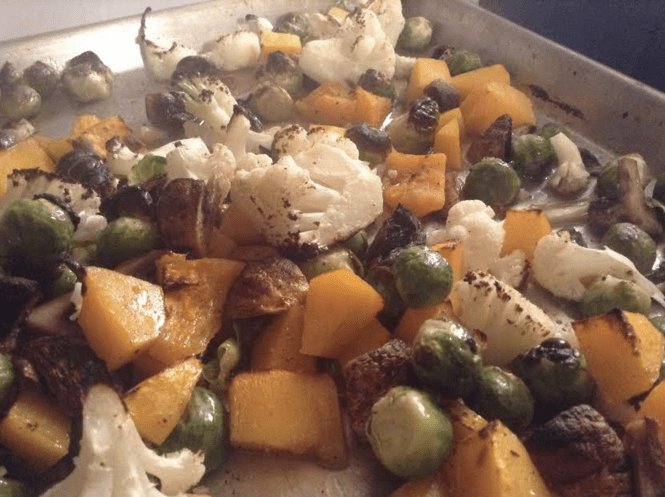
For the vegetables, I combined a pound of whole baby Brussels sprouts, one head of cauliflower florets, one cubed butternut squash, and a pound of quartered mushrooms. I spread them in a shallow pan in a single layer, then drizzled them with honey, olive oil, and red wine vinegar, rustled it up a bit, and sprinkled salt and pepper on top. Then I slid it right under a hot broiler until it was a little bit charred.
For the record, this was a completely magnificent meal. The risotto was creamy and savory; the vegetables were toothsome and sweet. I was the only one in my house who thought so. Corn flakes and frozen pizza were consumed. Too bad for them.
I also ate kind of a lot of pretzels dipped in blue cheese sauce while waiting for the Instant Pot to stop venting.
WEDNESDAY
Pulled pork sandwiches; fries
Wednesday was a snow day, and since we are having guests on the weekend, I made the kids do a lot of cleaning. One cleaned out the refrigerator. She found a small bowl of some lumpy, white substance, and she . . . threw it out. Thus was broken the thrall of blue cheese sauce over my heart.
For the pulled pork, I just chunked the meat into two slow cookers with some Narragansett beer, a lot of salt, pepper, and garlic powder, and the remains of some jars of sweet pepper rings and jalapeno peppers with the juice, and put it on low for six hours.
This meal never tastes quite as good as it smells, but it smells like a meat god has descended on your kitchen and it will be your last day on earth, so I guess a step or two down from that is okay. I served the meat with sub rolls, bottled BBQ sauce, and red onions.
I brought up the possibility of broccoli, but everyone just flapped their hands at me dismally, so I saved myself the effort.
THURSDAY
Ham and egg English muffin sandwiches
With a side of No-Choice Broccoli.
FRIDAY
Oh, wait till I tell you. A friendly priest is passing through the area, and arranged for this to be delivered:
and this:
So, I’m gonna get some beer and some French bread and make some green salad and potato salad and rice, and I believe we’re going to have a Vendredi Gras (?).
And what about you, ma fren? Do you have plans for Mardi Gras?
Or, you combine them. YASS. Both/and; so Catholic. Here are a few ideas for how to combine romance and suffering, sweetness and pain.
GIFTS OF FINEST CAROB Remember carob? It looks like chocolate that’s been sitting in a dusty corner for a while, and it tastes like a chocolately dusty corner. Fasting just got that much easier! Give your significant other a satiny, heart-shaped box packed with an assortment of carob truffles, and you will be transmitting a powerful Lenten message: we must not be seduced by the passing allure of temporal things, for the sweetness of this world is but a ackkkk, blech, ptui, what is this?
QUEEN VICTORIA’S SECRET We’re required to abstain from meat, but other kinds of abstinence? Not obligatory. On the other hand, you don’t want to start your Lent too carnal-like. So try this easy trick: pick out something satiny or lacy, but at least four sizes too large. As the lucky lady opens the box, you can wiggle your eyebrows suggestively while explaining, “You really put the “gras” in Mardi Gras this year, Marty!” (This works better if your wife’s name is Marty.) I guarantee you, no sins of fleshly excess will threaten your evening. Unless you count “stabbing” as a sin of fleshly excess.
SEASONALLY APPROPRIATE FLOWERS Take a leaf from liturgical decorators around the country: go out back where the dumpsters are, pull up some dead grass, and add a few twiggy things and maybe a really scuzzy looking cattail. Stick it in a pot, preferably one that looks like grandma got into the clay again. Voila — Lent flowers! In a similar vein, if you know your wife or girlfriend was hoping for perfume, you can substitute sand, because sand is symbolic and whatnot.
HEIRLOOM JEWELRY Any unimaginative bozo can stumble into Zales and pick out a diamond this or a ruby that. What you want is something that is not only decorative, but also saturated in spiritual significance. So go ahead and rummage through the lost and found box on the radiator at the back of the church. Maybe you’ll find a nice, broken-in scapular, already “seasoned” with the holy emanations of countless fervent necks. Or maybe you’ll really luck out and find a miraculous medal that’s so well-prayed-on, it’s gone full manatee. Jackpot!
A LOVE LETTER TELLING YOUR BELOVED HOW YOU REALLY FEEL. . . about the state of his or her soul. True love doesn’t sit by and let other people wallow in sin. Consider a hand-penned, calligraphic examination of his or her conscience. Or you might assemble a “dream team” of hand-selected patron saints which you will be assigning to the cause of your beloved’s salvation (St. Drogo, St. Fiacre and, of course, St. Jude spring to mind). Or simply borrow some lyric lines from scripture. I suggest Jeremiah. There are also some really exquisite passages in Hosea.